Showing posts with label Raul Castro. Show all posts

09 July, 2010

So what now for Cuba?

By Jorge Reyes

When Raúl Castro took on the reigns of power Cuba, many people though skeptical actually had hopes that some political opening would take place in Cuba. I, like them, were wrong.

The Cuban government under him has continued to harass and jail political dissenters—even as the blogosphere, egged on by TV stations in Miami, provides new ways for some Cubans to express their criticism.

A couple of days ago, the Cuban government announced that fifty-two political political prisoners will be released, after a decision made after the archbishop of Havana and the Spanish foreign minister interceded directly with Raúl Castro himself. The announcement is good news and a welcome relief to many observers, not to mention the prisoners' families. They have been through enough since their arrest in 2003.

According to Freedom House, this is a welcome posture but don't forget that there are 167 other political prisoners of whom very little has been spoken about. 

Is this a new willingness by Castro to tolerate dissent? To stop harassing people whose only crime is simply to act and think differently?

Some have seen this as a major concession by the Castro government, and in many ways it is. Whatever this may ultimately lead to, let's see what this is not about.

Throughout the years, there have been many negotiated releases with very little political change. 

In 1984, Jesse Jackson convinced Fidel Castro to release twenty-six political.  In 1996, Bill Richardson secured the release of three.  In 2002, Jimmy Carter got one prisoner released. In 1995, the Human Rights Watch managed to get half a dozen released after six grueling hours of negotiation with Fidel Castro in 1995. Pope John Paul II has been the most successful negotiator thus far, who in 1998 obtained the release of eighty jailed dissidents.

Those prisoner releases were also welcome news at the time each occurred. But they did not bring an end to repression in Cuba. The government never stopped locking up its critics and stifling dissent on the island. There is little reason to think this time will be different. Since Raúl Castro took over from his ailing brother in 2006, the Cuban government has jailed scores of political prisoners, including journalists, human rights defenders, and ordinary citizens engaged in “counterrevolutionary” activities. None of these newer prisoners are among the fifty-two the government now plans to release.

In any case, for now, only five of the fifty-two will actually leave prison—and apparently not for their homes, but rather for forced exile to Spain. “They will go directly from the prisons to the planes,” Cuban blogger Yoani Sánchez wrote on Wednesday, citing “a gentleman who keeps his ear glued to the radio” listening to “the prohibited broadcasts from the North.

"The ability to rid themselves of the inconvenient," she continues, "the skill to push off the island platform anyone who opposes them, this is a talent in which our leaders are quite adept…. [S]o many Cubans find themselves caught between the walls of prison and the sword of exile.”

Also, Yoani's sentiments are equally shared by many editorials worldwide.  As Daniel Calingaert, deputy director of Freedom House said: "we’re concerned that these prisoners are being forced to leave Cuba as a condition of their release and, in this way, the Cuban government is trying to physically remove political opposition from the island. The Cuban government should respect the right of its citizens to return home.”

There are no easy answers when it comes to Cuba.

I, for one, has stopped thinking of possible scenarios. What is true is that the release of political prisoners won't do anything to solve any of Cuba's political problems. I was always of the belief that by simply opening an immigration valve allowing Cubans to leave the island, we were doing more harm against the cause of Cuba's freedom than not.  It doesn't solve anything.  It leaves a vacuum for any meaningful and strong dissent. 

Now these 52 released political prisoners are forced to leave Cuba and live somewhere else, like thousands of other dissidents have done. The other political prisoners will remain locked up, their voices muffled, and the dissident movement as weak as ever.

That has always been the problem that has plagued the Cuban nation; those who should stay behind and fight leave by choice or are forced to leave. Others simply remain to whatever they can do to solve a seemingly intractable situation; their voices barely audible in a din of repressive revolutionary distopia.

19 June, 2008

Mariela Castro's triumph: free sex change surgeries in Cuba.


by Jorge Reyes

There are things in life that never cease to amaze me. Recently I was approached by the editor of a newspaper to consider the possibilities of writing an article about Cuba's latest social and legal policy: the approval of giving transsexuals in Cuba free sex operations for anyone who qualified.

In a country that boasts of having free medical services, this shouldn't have been surprising except for the fact that the type of free medical services that will be provided is nothing less than a sex change surgery and the legal change of identity.

Wow. Is this all?

As of the writing of this, there are already:

28 qualifying diagnosed transsexuals;
19 of whom want to undergo surgery;
8 do not want to undergo surgery, but they want to change their legal identity;
13 have successfully been able to change their names and replace the photo on their identity cards;
7 are waiting approval by the Justice Ministry for their legal changes.


But this is the thing, it gets even stranger still.

The move to legalize such amazing social policy has been strongly supported by none other than Mariela Castro, president Raul Castro's own daughter. Mariela, a sexologist, heads the National Center for Sex Education (CENESEX), and she's not shy about the role she played in bringing about the successful implementation of Resolution 126, as it is known, which was signed into law on June 4 of this year.

As of late, she has openly and publicly criticized Cuba's homophobia and has even apologized for her own family's role in the forceful imprisonment of gays and lesbians in the past. In the 1960's, Cuba would simply incarcerate or send to labor camps anyone suspected of being weak or effeminate. Fast-forward to 2008, and what you will get is a gay and lesbian society that doesn't seem to mince words or live in a half-world of double-truths.

Long, it seems, are the days when Cuban writers, intellectuals or others were simply socially ostracized, arrested or deported to other countries merely for suggesting anything that went against the heterosexual machismo mores of the times. All one has to do is read Reinaldo Arenas's memoirs, novels and short-stories. I won't go into any detail about these literary gems, suffice it to say that when he died of AIDS Mr. Arenas left behind a harrowing first-person narrative of what it was like growing up gay in Castro's Cuba during the 1960's and 1970's. And it wasn't pretty.

Even Fidel Castro gave an equally quoted interview in 1965 where he said "there are no homosexuals in the countryside." By 1992, Castro  seems to have changed his mind.

But how did these changes occur without many people even discussing outside of Cuba remains a mystery. Why in Cuba, of all places, remains an even greater mystery.

What's perhaps odd, to me at least, is that before any substantial social policy takes place, a majority of the populace must have accepted such changes. In less than thirty years (and that's a brief time in a country totally micromanaged by the communist party), homosexuality went from being penalized to something that seems accepted, within limits.

I suppose that lots of credits must be given to Mariela Castro herself and the interest she's taken on behalf of a group of people largely misunderstood. She's said that for many years she tried to change her dad's own views on homosexuality and that he, far from encouraging at first, cautioned her later to be prudent and to continue with her activism.

It's difficult to predict how far these changes will go towards slowly moving away from a monolithic political system, and how much Raul Castro will tolerate.  There could be a political backlash. As a friend of mine from London wrote me in a email, she hopes that these changes are not simply cosmetic in nature and used as a ruse to imprison gays and lesbians later on.

I don't think that's the case; first, the Cuban government, far from being a politically pluralistic society, didn't have to open up a space for Cuba's gay, lesbian, transsexual and trans-gendered community in order to retaliate against them later on. Yet it did and it's curious that while in the past it has lumped members of the GLBT community with political reactionaries, this time it hasn't and, in fact, separated them altogether as a potential political threat.  Don't fool yourselves, it could happen even with Mariela's best intentions.


Cuba's ratification into law of Resolution 126 as well as the striving to fully integrate members of the gay, lesbian, trans-gendered and transsexual community to the forefront of public discourse and legal rights seem to be the most liberal and ambitious of its kind in the Western hemisphere, including its neighbor to the north the United States.  (By the way, Mexico just this week seems to be on the forefront of progressives social policies as well legalizing gay marriages, another one of its kind simply because Mexican society is still dominated by the old prejudices and that equally hypocritical Machismo mentality.)

If Cuba's government continues on this road towards a semblance of pluralism, Raul Castro's Cuba may follow a path unlike any of us had ever expected. Others are very skeptical that this will translate into any form of political openness.  They argue that this is just a little band-aid given to an oozing problem.  It remains to be seen, though, if these changes however slow can also be irreversible. 
Time will tell.  One never knows what's going to happen in Cuba from one minute to the next.

18 December, 2007

The Castro Story after Castro


It seems that to write about Cuba has become a pastiche these days. It is equally true that for some us, writing about and living the Cuban story has been a fascinating story-- a story often interpreted as the tale of a few romantic radicals and other times as the tale full of tragedy and despair. Romance, like life, is a bittersweet story rarely ending happily.

The facts about the 1959 Cuban Revolution, as always, and the "truth" about it are somewhere in the middle, shaded in half-truths and half-lies.

When Castro and his bearded rebels gained political power that fateful night of December 29, 1959, there was much theatrics similar to the vitriolic sort of political experience Cubans have known since Cuba's independence from Spain in 1896. Cuba's political reality since its independence never matured to the level that it could produce anything other than what it had, sudden spurts of well-intentioned politicians boasting of lofty ideals that never came true and which always, without exception, ended in political corruption. As Ramon Eduardo Ruiz wrote in his now classic book, Cuba: the Making of A Revolution, the revolution, its ideals and aspirations did not represent a radical break with the past; it was a continuance of the past developing to the point where Fidel Castro could, literally, claim himself to be one day dictator for life, Communist or not. And when that happened, it was irrelevant if he believed in his socialism or whether he was just an opportunist.

The fact that Castro played upon the myths and lore of Cuba's realities didn't go unnoticed by many. Some, including members of the Communist party, saw him as bad news. His political maturity and left-wing ideals, fomented after he gained power, was subtle, a test of wills and luck he balanced until, finally, he moved on to the Soviet camp, proclaiming, one night, that he'd be a Communist until the day he died, while a white dove perched quietly on his shoulders. The strange combination of messianic leader turned savior turned daemon has lasted to this very day.

But communism, just as much as capitalism for that matter, was never much a part of Cuba's political reality before or after 1959. What Cuba had, at least politically, was a dependence on US interests as much as it depended later on Marxism until, finally, it sold its soul to Fidelismo, a political movement in need of research as much as the Third Reich has been.

Hence enters into this Shakespearean political scene a man with great appetites, large intellect, and a vision for himself which was as much opportunism as luck, to paraphrase Georgia Anne Geyer in her book Guerrilla Prince; a man none of us have been able to get rid in more than a quarter of a century; a man still on everyone's lips. And, coincidentally, whether you loved him or hated him, this man was also very smart. His intellect drew upon a rich eclecticism that oversaw the construction of a society divided and torn by complexity on all sides, worldwide, wherever there is a Cuban. It was a society built on a legitimized form of Machiavellian strata. The fact that it was a legitimized police state made it worse.

For good or bad, Castro has outlasted eight American and five Russian presidents. It set into a motion a geopolitical change that not only changed the dynamics of present-day Cuba, but South Florida and the world beyond.

Today, each of us has gotten used to the old doddering dictator. What most see in Castro, at most, is an intelligent but decrepit though benevolent head of state. A man hard from being perfect, but someone for whom many don't see him as the devil incarnate as many of my older members of my family saw him. Of course, there's a new generation to whom the post Cold War realities of present-day living is just part of the annals of history. Something interesting, but relegated to the pages of yellowed newspapers, like watching reruns of I Love Lucy.

No one is immortal and just a few days ago Reuters announced that Castro, a man who has not been seen public in 16 months, might have submitted his resignation as head of Cuban government.

“My elemental duty is not to hold on to positions and less to obstruct the path of younger people,” the 80-year-old Castro said in a letter read on the Cuban state-run television program, La Mesa Redonda. Castro continued by saying that his duty is “to contribute experience and ideas whose modest value comes from the exceptional times that I have lived through.”

This comes on the heels of the death of his sister-in-law, Vilma Espin, who passed away of an undisclosed illness on July, 2006. Up until then, there has been no official report of any death in the much tight-lipped Castro family. Espin was married to Raul Castro, to whom Castro ceded power to as head of state in 2006. Castro, though, still holds the posts of president of the Council of State and Council of Ministers, and first secretary of the ruling Communist Party.

But neither were Raul Castro nor Vilma Espin, nor anyone who may replace any of them as head of state, can fill the gap of Fidel Castro himself; even had Castro died and the Raul-Vilma duo could have filled the gap and entered a decade of some sort of centrist socialist country, this posture couldn't have lasted for long since the center of the dynamic that became the Cuban Revolution could have outlasted its "Top Dog", Fidel himself.

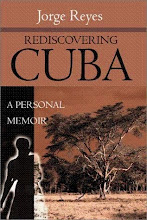
Some years ago I wrote a book about returning to Cuba, Rediscovering Cuba: A Personal Memoir. My ideas then, as much as they are now, have changed little. Cuba's present-day reality is complex, too complex. Many people have an interest in Cuba's future, and many have a stake and a moral right, too, at rewriting its history. At the time that I published my book, I sent a copy of the book to one of Castro's sister, Juana Castro, who lives in Southern Florida and who has never seen her brothers since the early 1960's when she left Cuba. In the brief conversation she and I had, what I found in her is the same type of closely-guarded testimony of a Cuban who not only is divided between family love and the divisions all too common for the Cuban people. Juana Castro congratulated me on the publication of my book. I said that I was honored that she'd taken her time to call me. The conversation was polite, but distant. She knew I could have thrashed and demonized the family whose name she bears, the Castro name. I honestly hadn't. But what I found in her was that when it comes to speaking about Cuba, there are no easy answers. I refrained from asking too many indiscreet questions about her brothers, about her family, about her views on Cuba. She herself kept mum about saying anything at all. Hence the intractable silence, the impasse that exists between two countries, two people, and misunderstanding amonng generations subtly divided over an issue that in the past was easy to ascertain as one cause, with one name-- with one common hatred.