Showing posts with label Cuba. Show all posts

01 February, 2010

Cuba's "Los Van Van" concert in Miami not as divisive to Cuban-Americans as it once was

by Jorge Reyes

The first thing my mother said when I told her the Cuban band Los Van Van was going to perform in Miami was: “Wow, what memories.”  She, of course, was reminiscing about a band she remembers fondly from her youth, a band that led by Juan Formell celebrates its 40th anniversary with an international tour, which kicked off with a concert in Key West on Sunday night.

If you're somewhat familiar with Cuban issues this may be yet another instance of our seemingly intractable political impasse.  If you're not familiar with Cuban issues at all and your only idea of Cubans in Miami is via the Elian Gonzalez saga, you must be trying to figure out what all the fuzz is about.

In a nutshell, for years Cubans in Miami have refused to welcome any performer or any other public figure who lives in Cuba.  Anyone disagreeing with this mentality has been called everything from fascist to terrorist to, worse, murderer.  I kid you know.  Whether this is true or not, to the exiles anyone who stayed behind is representative of a communist regime, and that's enough to ostracize them in a free country such as ours.    

This all makes for some weird bad publicity to Cuban-Americans.

To the outside world, Cubans in exile seem like a throwback of another age; a community that does love this country and has done relatively well, yet seems to have very little respect for the first amendment.  That's a shame, though, for it is a myth; one that may be shared, perhaps rightfully so, by that first generation of immigrant Cubans still yearning to return to the Cuba of their dreams in a few month's time; those who think the world has remained still since they first fled a political dictatorship in the early 1960's; those who think the Cold War is still a political presence to be fought.  All of that has been a myth; a myth because it simply isn't true any longer.

Thankfully also, the geopolitical issues of 1959 are not those of 2010.

Times do change, folks, and when Los Van Van played last night in the James L. Knight Center, a cultural shift of sorts seems to have occurred in only a decades' time since they played last in Miami in 1999.  At that time, there were more protesters than concert-goers.  This time around, things were different. Radically different.  As reported in the news media, of all the thousands of protesters expected only about 350 showed up.  The views of a new generation of Cubans seems to have shifted from that of their ancestors.  And that, I think, is a good thing.

For many years, one of the things I've always said is that the Cuban community is not a monolithic group.  We have different views on a plethora of issues, including the Cuban embargo, Castro, and what we would hope happens in the last communist country in the western hemisphere.  I once gave a lecture about a book I wrote about Cuba.  Halfway into the lecture,  I got into verbal scuffle with a lady who defied and interrupted every word I said every time I mentioned what I consider to be the foolishness of maintaining the Cuban embargo.  Call it what you want, but that's how discussions about Cuba end up mainly among Cubans-- personal and highly emotional personal attacks.  That's it. 

Dissidents like me who do not share the either/or mentality of the Cuban exiled community for decades have been the most silent minority due in large part to us not wanting to go against the tribe. In the past, to speak and think differently in my South Florida community is often an attempt in intellectual futility and outright censorship.

But regardless of how you feel about this topic, what 4,000 concert-goers did seem to say is that changes can happen, and often in subtle ways.  After all, what happened to the thousands of protesters that showed up during the last concert in 1999? Did they suddenly die?  Did they have a change of heart?  Are they looking at alternatives ways to end what I call the Cuban impasse?  I wish it's the former for that would imply a different strategy towards the betterment of a 50-year old fractured and volatile relationship.

Protesters, of course, have of course have a perfect right to peacefully protest against anyone they choose to.  Obviously the fact that Cubans are displaced all over the world is significant.  What they don't have a right to do is stifle speech, dissent, or music as in the past.   But how do we change this state of mind?  By further dividing our sense of nationhood against anyone immediately branded a communist? Or by using events, such as a concert, to narrow the gap of our great divide? 

What Los Van Van concert shouldn't be about is politics. That, unfortunately, is what it has always degenerated into.  What it should be about is culture and the arts, something alien it seems to many who hold on to this erroneous belief. 

And this is the bottom line: some famous Cubans have chosen to remain in the country of their birth and not try their luck somewhere else.  Like Los Van Van, I can name a few: writers like the well-known author Alejo Carpentier and actors like Rosita Fornes.  Whatever their personal reasons for staying in Cuba, the discussion should not solely focus on their political views, if at all.  What is important, though, is how we interact with one another from now on and how we choose to engage in a substantive conversation about where we go from here.  Hurling glass bottles and empty cans of sodas is hardly the way to be heard above the dim of ad hominens.

Which is probably what my mother had in mind when I told her that Los Van Van were going to play in the sunshine state.  The sudden joy in her face told me of another story, and another Cuban.  One that is not political.  One that is not divided.  One that can careless about any of the things we are often guilty by association.  Not once did she think of politics, Castro, or the so-called "exiles."  To her it was just about remembering her past, and that had nothing to do with politics.  Thank goodness.

18 December, 2007

The Castro Story after Castro


It seems that to write about Cuba has become a pastiche these days. It is equally true that for some us, writing about and living the Cuban story has been a fascinating story-- a story often interpreted as the tale of a few romantic radicals and other times as the tale full of tragedy and despair. Romance, like life, is a bittersweet story rarely ending happily.

The facts about the 1959 Cuban Revolution, as always, and the "truth" about it are somewhere in the middle, shaded in half-truths and half-lies.

When Castro and his bearded rebels gained political power that fateful night of December 29, 1959, there was much theatrics similar to the vitriolic sort of political experience Cubans have known since Cuba's independence from Spain in 1896. Cuba's political reality since its independence never matured to the level that it could produce anything other than what it had, sudden spurts of well-intentioned politicians boasting of lofty ideals that never came true and which always, without exception, ended in political corruption. As Ramon Eduardo Ruiz wrote in his now classic book, Cuba: the Making of A Revolution, the revolution, its ideals and aspirations did not represent a radical break with the past; it was a continuance of the past developing to the point where Fidel Castro could, literally, claim himself to be one day dictator for life, Communist or not. And when that happened, it was irrelevant if he believed in his socialism or whether he was just an opportunist.

The fact that Castro played upon the myths and lore of Cuba's realities didn't go unnoticed by many. Some, including members of the Communist party, saw him as bad news. His political maturity and left-wing ideals, fomented after he gained power, was subtle, a test of wills and luck he balanced until, finally, he moved on to the Soviet camp, proclaiming, one night, that he'd be a Communist until the day he died, while a white dove perched quietly on his shoulders. The strange combination of messianic leader turned savior turned daemon has lasted to this very day.

But communism, just as much as capitalism for that matter, was never much a part of Cuba's political reality before or after 1959. What Cuba had, at least politically, was a dependence on US interests as much as it depended later on Marxism until, finally, it sold its soul to Fidelismo, a political movement in need of research as much as the Third Reich has been.

Hence enters into this Shakespearean political scene a man with great appetites, large intellect, and a vision for himself which was as much opportunism as luck, to paraphrase Georgia Anne Geyer in her book Guerrilla Prince; a man none of us have been able to get rid in more than a quarter of a century; a man still on everyone's lips. And, coincidentally, whether you loved him or hated him, this man was also very smart. His intellect drew upon a rich eclecticism that oversaw the construction of a society divided and torn by complexity on all sides, worldwide, wherever there is a Cuban. It was a society built on a legitimized form of Machiavellian strata. The fact that it was a legitimized police state made it worse.

For good or bad, Castro has outlasted eight American and five Russian presidents. It set into a motion a geopolitical change that not only changed the dynamics of present-day Cuba, but South Florida and the world beyond.

Today, each of us has gotten used to the old doddering dictator. What most see in Castro, at most, is an intelligent but decrepit though benevolent head of state. A man hard from being perfect, but someone for whom many don't see him as the devil incarnate as many of my older members of my family saw him. Of course, there's a new generation to whom the post Cold War realities of present-day living is just part of the annals of history. Something interesting, but relegated to the pages of yellowed newspapers, like watching reruns of I Love Lucy.

No one is immortal and just a few days ago Reuters announced that Castro, a man who has not been seen public in 16 months, might have submitted his resignation as head of Cuban government.

“My elemental duty is not to hold on to positions and less to obstruct the path of younger people,” the 80-year-old Castro said in a letter read on the Cuban state-run television program, La Mesa Redonda. Castro continued by saying that his duty is “to contribute experience and ideas whose modest value comes from the exceptional times that I have lived through.”

This comes on the heels of the death of his sister-in-law, Vilma Espin, who passed away of an undisclosed illness on July, 2006. Up until then, there has been no official report of any death in the much tight-lipped Castro family. Espin was married to Raul Castro, to whom Castro ceded power to as head of state in 2006. Castro, though, still holds the posts of president of the Council of State and Council of Ministers, and first secretary of the ruling Communist Party.

But neither were Raul Castro nor Vilma Espin, nor anyone who may replace any of them as head of state, can fill the gap of Fidel Castro himself; even had Castro died and the Raul-Vilma duo could have filled the gap and entered a decade of some sort of centrist socialist country, this posture couldn't have lasted for long since the center of the dynamic that became the Cuban Revolution could have outlasted its "Top Dog", Fidel himself.

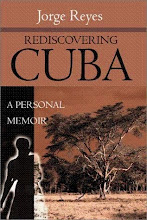
Some years ago I wrote a book about returning to Cuba, Rediscovering Cuba: A Personal Memoir. My ideas then, as much as they are now, have changed little. Cuba's present-day reality is complex, too complex. Many people have an interest in Cuba's future, and many have a stake and a moral right, too, at rewriting its history. At the time that I published my book, I sent a copy of the book to one of Castro's sister, Juana Castro, who lives in Southern Florida and who has never seen her brothers since the early 1960's when she left Cuba. In the brief conversation she and I had, what I found in her is the same type of closely-guarded testimony of a Cuban who not only is divided between family love and the divisions all too common for the Cuban people. Juana Castro congratulated me on the publication of my book. I said that I was honored that she'd taken her time to call me. The conversation was polite, but distant. She knew I could have thrashed and demonized the family whose name she bears, the Castro name. I honestly hadn't. But what I found in her was that when it comes to speaking about Cuba, there are no easy answers. I refrained from asking too many indiscreet questions about her brothers, about her family, about her views on Cuba. She herself kept mum about saying anything at all. Hence the intractable silence, the impasse that exists between two countries, two people, and misunderstanding amonng generations subtly divided over an issue that in the past was easy to ascertain as one cause, with one name-- with one common hatred.

18 December, 2006

Of Death, Mortality, and Fidel Castro


By Jorge Reyes

How incredibly to realize that after so long, it seems that the man we all hate to love is finally meeting his own mortality. I'm referring to Fidel Castro, someone who at least for a while seemed to have discovered the secret of life.

It only seemed that way. But even Fidel seems to be taking his own death with moderation and, like John Paul II, making the most even out of dying.

I'm amazed how some still compare present day Cuba to the man we love to hate, Fidel Castro himself, as if Cuba, the Cuban people, the very heart and soul of that small, crocodile-shaped island in the Caribbean, were synonymous with Fidel.  Of course, it isn't, and disentangling both will be what most call for a future reconciliation. 

It wasn't after I returned to the country of my native birth after more than twenty years of absence, that I began to think for myself-- independently of familial or personal prejudices-- of what we, Cubans the world over, have been doing wrong for fifty years or for as long as, well, what seems like Biblical times. 

Simply put, there's an either/or mentality when it comes to Cuba, "a la Fidel." Hence, we are our own worst judges by advocating policies that personal, emotional and irrations because they stem from the heart.  The US embargo, for example, is a failure.  It always was.  It always will be.  Simple as that.

Yet, we've capitulated to Fidel by advocating and remaining stuck in a Cold War relic which still, to my amazement, many if not most Cubans living in exile, still seem to think is Cuba's only salvation.

I love to corrupt the minds of the youth, therefore I will go the extra mile and advocate to destroy this stupid embargo-mentality: if the US embargo against Cuba is the only rational policy that will, ultimately, depose Castro from power, howcome he's still in power? howcome his power is now even on his deathbed more entrenched than ever?

We've advocated the wrong policy. 

And yet, we have Congressmen and Congresswomen in the US government who's sole ticket to fame has been their good-faith attempts to misinterpret what they, themselves, must know is a failure. Like our deepest passions, the US policy against Cuba since 1959 has been anything but rational.  Rather it has shared some of the personal vitriol, one decybel too high. 

I left Cuba with my parents when I was eight years old in 1982. I returned almost twenty years later as a result of my grandmother's illness, which killed her six months after a diagnosis of a rare form of cancer. Luckily, if not hastely and unprepared, my mother, an aunt and I returned to our strangely familiar land. To say much is to veer off into nostalgia. To say too little about our emotions is to be a hypocrite. Returning to Cuba was a mixbag of emotions.  My experiences in Cuba eventually became a published book titled, Rediscovering Cuba: A Personal Memoir, a book which is still in print and which, as the years go by, has proven truer than I believed when I penned the small tome.

I wrote intensely. I wrote and poured my heart out. Basically, I blamed this disaster that has befallen the Cuban nation on all of us-- every single Cuban who made a choice to either leave or stay; to curse and moan against the Castro clan or capitulate and give in, instead of fight. 

Since I wrote the book, I've become a bit more political, which is something I tried to stay away from when I was in the process of writing the book. But every discussion about Cuba eventually turns political. 

Still, my beliefs remain non-sectarian when it comes to politics because it is my strong belief that openess, not isolation, communication, not censure, is what creates a healthy environment to live, raise families and become the person each of us is meant to be.

Book aside (and personal feelings), my journey through Cuba became part of a wonderful collection of pictures I took of local places, local people, and folkloric scenery. These wonderful images and not just the typical images of Cuba with, well, by now you know who, that Biblical Patriarch, is Cuba. Whether Communist or none of the above, whether exiled in Miami or New York City or Paris or whether living under a palm-thatched 'bohio' somewhere in an isolated town, 'this is Cuba', to paraphrase a Cuban/Russian film of the same title.

Long after He is gone, long after His face is just another failed god like Lenin or a sort of historic curiosity, a rebirth of a new Cuba will spring even if from incremental hopes and dreams, and when that day comes we'll all wonder why we didn't think of opening the windows to this beautiful paradise if but just a tiny crack at a time.....