24 December, 2009

Multicultural Santa Claus


by Jorge Reyes

I still remember how around this time of the year both my parents would dutifully take me to a nearby toystore so that I could tell Santa what I wanted for Christmas and then have my picture taken with him.  I'm sure most of us cherish these pictures of long-ago like religious relics.

The best Christmas gift I recall getting from Santa was an Atari 5200 videogame system. I was the envy of the neighborhood's kids. With time and the South Florida humidity, I'm still surprised to see how well some of these pictures have withstood the merciless test of time. (Of course, I'd like to think that it hasn't been that long ago, though the last picture I was forced to take with dear Santa must have been more than twenty-five years ago.)

But these are just cute childhood memories and images, if such they ever were, and most of which I haven't see fit to reminisce for decades.

Out of simple curiosity and nostalgia, not too long I drove by the same toystore which is located in one of those gray, squat shopping centers in the city of Hialeah, where I grew up.  To my surprise, the toystore was still open for business, though the same cannot be said of its next door competitor Zayre- the local Walmart of its day. Does anyone remember Zayre or am I the only one living in the past? 

Hialeah, of course, is a sort of mecca for Cuban immigrants who started to arrive in the early 1960's for what they tought would be a short-term exile vacation, but who have overstayed their visit for more than fifty years now. For the record, Hialeah has a near 90% Hispanic population.

Very little has changed about the toystore or about the traditional Santa Claus picture. Parents were still actively engaged in having their kids sit on Santa's lap, whisper in his ears what they wanted for Christmas, and then perhaps go home for the hoped-for gifts. What has changed, to my amazement, was that this particular Santa had an accent of sorts “Ho, Ho, Ho, Merry Christmas” sounded more like the accented Spanglish language spoken in Hialeah, and in many other areas of Southern Florida. 

Oh yes, this Santa had rouged-rosy cheeks, a fake white beard like cotton, and was dressed in his red fatigues, though he wasn't as corpulent or as tall as the iconic one I remembered in this same spot. No matter, kids and their parents were as excited to go through this holiday ritual as if their lives, and their prospects for a new year, depended on it. Most likely after the ritualized picture-taking, they went home and started to cook one of their roast pigs richly marinated with salsa criolla, for an evening of Latin festivities-- with a Santa swinging to the hips with merengue music as well.

So much has changed and so little at the same time.  What has changed is the way we seem to tolerate a multicultural society that, surprisingly, gets along so well. Drive to Little Haiti near Biscayne Boulevard and you probably will find an equally engaging black Santa Claus speaking Creole. As never before, South Florida seems to be aware of a cultural diversity that, at least in my childhood days waiting in line for Santa, would have been an embarrassment to see.

As an immigrant, long gone are the days when we spoke with references to assimilation rather than as we speak these days of diversity. To be an assimilated Cuban boy was what my family taught me.  Diversity stayed at home, in the privacy of family get-togethers.  Back in the old days, to be an immigrant was felt as much within the family structure as in the cultural environment, which made forgetting the past more difficult but an inevitable part of life lest one would go crazy.  That mentality, of course, is no longer applicable and I'm ashamed to admit I still think in those terms. That's why I don't know how to dance salsa or merengue to this day.  Damn, I never thought I'd say this: I'm old school!

Though I seem to be stuck in an old view, institutions seem to have surpassed me. 

The Fraternal Order of Real Bearded Santas recently hosted a convention of Santas in California, and most of these Santas were overheard wishing people Spanish holiday greetings. The Charles J. Howard Santa Claus School, which is (believe it or not) a school for Santas, recently taught their Santa in a three-day course how to deliver gifts in traditional reindeers, as well as in horses and donkeys.

At Aventura Mall right here in Miami, some Santas are still monolingual, but their helpers seem to a diverse group of people who speak different languages. I have yet to see a bilingual Mrs. Santa. Give it time, it will happen.

This is not to say that we live in an ideal society. We have problems, though they are more subtle and often imperceptible. Our laws no longer permit “de jure” discrimination, though there is still a “de facto” discrimination of sorts. I am also fully aware if I drive North where the population is more homogeneous, I might less and less of the type of Santas I have seen in Miami. But it doesn't matter, the fact that these Santas exist proves that there is far more willingness to accept what has hitherto been unacceptable up until recently. Santa is, after all, a powerful symbol and I'm reminded of Paul Valery's quote “What would become of us without the help of what doesn't exist?”

Let's use Santa therefore, even if he doesn't exist, for good.

Which brings me, once again, to this nostalgic time of the year when the days get shorter, though it's simply the fact that the earth is rotating at its farthest from the sun. The pagans call this time of the year the Winter Solstice, a time when the forces of darkness seemed to be winning over the forces of light. I call this time of the year a time to remember the past for what it was, reevaluate the present for what it is, and reaccess areas where you will need to make changes. In more than twenty five years since I sat on Santa's lap, so much has changed in my life, to the world around me, that thinking about it makes those memories sweeter than they actually were. That's nostalgia for you.  I guess I'm growing old.

But that's all in the past. What matters is the present. And to everyone who is reading this all I can say is “Jo, Jo, Jo, Feliz Navidad! Merry Christmas everyone!”

19 December, 2009

Health care reform or more of the same?

by Jorge Reyes

As of the writing of this entry, the US Senate seems to be on the cusp of passing a wathered-down version of what's been called the health care reform bill. For some this is as much about the same thing without any structural changes to the way we do healthcare business, as it is about big power and money-interests dictating social policy.

What most people don't know yet is what the final bill will look like, its breath and scope, and how it will affect those 30 million men and women without any form of health insurance.

What is true is that diverse special interests have spent lots-- and I mean--lots of money to make sure that whatever Obama signs won't go along ways towards truly restructuring a dysfunctional, highly expensive and bureaucratic system.

Sadly, the health care reform looks more and more like what we have. Cut out is the public option plan, which in effect could have brought cost down by forcing private healthcare providers to compete with the government plan. Instead, what we seem to have is another form of government bail out program which, in effect, forces uninsured people to buy healthcare from private insurers. Think it over, big money interest have done all it could to make sure that a rather reasonable healthcare public option program is off the table in order to make sure that whatever subsidies the government gives to the uninsured goes to them in the long run.

Socialism? Well, in a way it is, but it's a trickle down form of socialism for corporations whose only interest is to maximize profits for their shareholders, those rich fat cats who have spent millions of dollars not only on Republicans, but conservative Democrats.  These are the so-called "corporate Democrats". 

According to the Center for Responsible Politics, a non-partisan group, the private health sector in 2008 gave $90.7 million dollars to Democratic candidates, compared to only $76.6 millions to Republicans. What these numbers mean is that Democrats are as much indebted to special interests as Republicans, if not more now.

No wonder Howard Dean has proposed to kill this bill and start over. As he reasoned, without a major overhaul to the cost of healthcare and without major competition between a government plan and the private sector, you can hardly call this healthcare bill reform.  I don't think that will happen because the 60th vote needed to pass the bill in the Senate will be found in order to show that something was finally done.

Yet, while the fleecing of America is occurring right in front of our very own eyes, the misinformation about what's going on continues to astound me. Talk to the average Joe about Obama, healthcare, the mortgage and financial crisis, and all you get is the usual retort that we're heading down the path of socialism because, as those "teabaggers" aptly testify to, America has been taken over by Big Government, illegal immigrants, and gays. That's it. No one seems to want to scratch at the surface of the undemocratic and systematic destruction of our rights by the blaring stupidities currently pre-packaged by the news media, at all levels.  For those who don't know "the teabaggers" they are a loose coalition of people that have formed in order to protest taxing policies and government spending, making use of confrontation in public meetings. 

All of this is a shame.

The public is less and less informed about what's happening and the capacity to think through issues seems to be diminishing. Our intellect is putrefying. When we don't like something we call it socialism and that's where the conversation ends.  Perhaps there should be socialism for the poor, it exists for the rich anyway. 

Which leads me to this question:  socialism for whom? and what the hell do people mean when they call any social policy they don't like socialism?  Wasn't the government bailout of Wall Street socialism?  Many don't think it is but look at it this way, in 2008 Wall Street made a record-breaking $180 billion dollars in corporate profits, enough to cancel out mortgage foreclosures for all Americans over the next four years.  You didn't see the same bailout to all those homeowners who have lost their homes to foreclosures or at the point of it? 

So on the cusp of a healthcare fiasco, this is where we are: a nation of know-nothings divided along class and ideological lines, but sadly bereft of any intellectual leadership or roadmap on any side of the political spectrum and with no idea where we're headed or what the future looks like.   President Obama, of course, has packed his cabinet with the same rich Wall Street financers who caused the current financial crisis. Not sure how he's going to face the voters who voted for him in 2008, but if he is as honest as he seems to be he should immediately distance himself from them and bring in a new group of advisers.

Make no mistake about it: if it's business as usual we all end up paying for the ever-spiralling and dysfunctional healthcare costs we currently have, and don't fool yourself, it is business as usual.


17 December, 2009

What's newsworthy anymore?

By Jorge Reyes

It's been a scandal-filled month. Most of the scandals have nothing to do with corrupt politicians or anything of a boring nature. Every one of these scandals involve sex and celebrities, of course. The most popular of them is, of course, Tiger Woods, the golf player. There are others and they have become equally titilating: the escort turned New York Post columnist, Ashley Dupre, and the state of Nevada, where male prostitution was finally legalized.

It's a shame TV evangelist Oral Roberts passed away this week, otherwise he would have raved and ranted against the promiscuous libertine sexual revolution of our current society. I'd hate to agree with him, but he's partially correct.

First the really juicy story, or the award for the most overrated news report, which is the Tiger Woods scandal. More and more women are coming to the fray claiming to have had tryists with Woods. These ladies have taken great steps to give a lot of details about the where, how, and when. Woods, of course, seems to have an affirmative action quota of sorts: all his mistress either have the same job-- either cocktail waitress, bouncers at clubs, or porn actress-- and he seems to like one type of woman-- white and predominantly blonde, like his wife.

Not sure if this is a joke or not, but his sexual indiscretion has given cause for a Tiger Woods Syndrome, or paranoid wives concerned that their nice, sweet, loving husbands may be having extramarital affairs.

For the sports world of golf and for Woods himself there's a far more serious consequence than all these women claiming to have had sex with him and that is the professional and personal loss of income he might experience in 2010. Advertisers have either dropped him already as in the case of the consulting company Accentura which paid him a reported $7 million a year, or are contemplating dropping him such as A&T. There are others.

Sexier story still is Ashley Dupre, the high price hooker who brought down ex NY governor Eliot Spitzer in 2008. I'm sure that neither Spitzer nor Dupre merit an introduction. When their sexual relationship was discovered, the news media simply saturated the airwaves with their story. The scandal doesn't seem to have affected Dupre's professional advancement. The same cannot be said of Spitzer. Dupre, it seems, has landed a regular advice column in the New York Post called aptly titled “Ask Ashley”. She answers questions close to her heart (and line of work) such as sex, love and relationships. The New York Post is unapologetic about this and seems to be basking in their own business savvy.

It's ironic, of course, that Dupre hasn't been one of Woods alledged mistress. In such closed-off world of high price prostitution and rich men, everyone seems to know each other.

But you never know. The Tiger Woods story is far from over and Ashley Dupre could have a few surprises in store for us. Time will tell.

But Woods and Dupre are not the only sexual creatures making headlines these days.

Ever heard of the Shady Lady Ranch? If you think it's some sort of religious cult a la Oral Roberts, you are wrong. It's actually a legal brothel in Nevada whose current owner, Bobbi Davis, must be in heaven these days-- figuratively speaking. You see, state officials in Nevada have finally legalized male prostitution, a profession illegal up until this point.

Female prostitution is nothing new in Nevada. It has been legal in that state since 1971. Prostitution is nothing new anywhere, of course, it has been part of every culture in any period of history. But male prostitutes in Nevada were out of luck since they were barred from this old (and often lucrative) profession due to a specific health law that called for prostitutes to have frequent cervical medical checkups for sexual transmitted diseases. Cervical medical checkups can only be done on women. But with the approval of urethra testing, which can be done on men, the male ban against male prostitution was lifted, and lo and behold, males can finally enter this profession hitherto blocked from them.

I'd dare say that soon we will have our very own infamous male Dupre. Watch for it.

Asides from the scandalous nature of any of these stories currently being disseminated as substantial news reports, I tend to think that none of them merit the level of media scrutiny that they have received. Sex sells and that's been proven, but respectable media organizations should know better.

As a nation we have lost all sense of proportionality, caring very little for degrees or levels of privacy which is at the core of the Tiger Woods scandal and many others. In Woods case, he is a public figure and the public needs to scrutinize the actions of its leaders and heroes, but I tend to think that there is a limit to how much we need to know, particularly if this involves a person's stupid actions which only concern his wife and his pozee of women, and then us, the public. Yet, news organizations have become saturated with his story and not one of them has refused to give fair time to the ever-growing number of women alleging they were his mistresses, regardless of whether their stories are true or not. Even if true, their stories on TV or the print media should have been limited in nature.

Many people in our society have become exhibitionist and we, in turn, we have become voyeuristic. Anyone, and I mean anyone, can claim to have something of any substance to say and we give them plenty of airtime, no matter how foolish and off the wall their claims might be.

The scandalous, I guess, has become the substantive and as a people we can't tell the difference any longer. And that, my friends, is a problem.

14 December, 2009

Barack Obama's Nobel Prize Oslo Speech


President Barack Obama's Nobel Prize Speech in Oslo has been both hailed and criticized due to its seeming contradictory nature. I take a different view and feel that there is nothing contradictory about his speech, about his vision and plan for peace, nor about the tactics he and his administration are willing to take at a time when he has sent an additional 30,000 troops to war-torn Afghanistan.

The only critique I have is the timing. After all, as of the writing of this entry Obama has been in office for only nine months.

His speech, a fine lesson in history about the relationship between war and peace, action vs. inaction, understands the complexities of the world, the ambitious nature of some nation-states and the role the US should take in order to tackle international threats that affect us all.

Unlike Bush, Obama didn't said that there was an "axis of evil" that must be fought unilaterally increasing our presence and imperial power abroad; instead, Obama chose to elucidate his belief that evil was a real presence in the world and it must be fought by engaging in a two-step process: engagement and sanctions with rogue nations.

Certain members of the media have referred to the seeming contradictions between the man and his words; between the man and his presidential actions; between his rhetoric and pragmatism.  Some have even written that engagement and sanctions is a failure that hasn't worked in the past.  In fact, many nation-states such as North Korea are so isolated that engagement is sure to result in failure. At other times, regime change has proven to be almost impossible, short of war. And international sanctions has proven very difficult to enforce.

Critics have gone on to say that in other areas, Obama has done all the right talking but failed to bring about results-- from climate change to nuclear arms control, from Iran and North Korean's atomic ambitions to US sanctions in Sudan. Human rights violations continue to exist in many parts of the world. The Israelis and Palestinians are still deadlocked over a two-state solution. And not to be forgotten, many still remember how Obama ducked meeting with the Dalai Lama in order to avoid a conflict with China.

Rightfully so, the world is not any less dangerous than it was yesterday; it is not any more peaceful because of Obama's personal vision, leadership, or policies. But what the speech did highlight is that engagement with the world continues to be fraught with real dangers and peace as much as war are never mutually exclusive.

Of all the people who liked Obama's speech was Sarah Palin who told USA Today she particularly liked his references to just war and the fallen nature of mankind.

As I wrote, the only problem that I see with this prize is the obvious fact: Obama has been president for only nine months and already he's been hailed as a modern day Gandhi and Martin Luther King, both leaders whom he mentioned throughout his speech. Very little time has been given to test the effects of an Obama Policy which is still in its infancy. But in all honesty, I don't think that at this point the Nobel Prize will be judged so much by its effects as much as by Obama's commitment to the basic principles he read, and for that reason alone I don't think a better political leader could have been chosen.


09 December, 2009

A Modest Proposal: execute gays and, God, save us from perdition!

by Jorge Reyes

No discussion is veiled in more hypocrisy but virulent attacks than the issue of gay-rights.  By “gay” I also include lesbians and transgendered people.  The attacks are usually more virulent if it is faulted for societal problems, such as the cause of a high divorce rate, pedophilia or bestiality even.  Never mind that gay men and women can lead happy, long-lasting and healthy relationships and partnerships.  Never mind that a sicko can be either straight or gay.  

Which brings me to the African state of Uganda, where an imperialistic war of religious values is taking place. 

Here's the scoop. 

On October 15, the state of Uganda introduced the Anti-Homosexuality Bill of 2009, that creates harsher penalties against homosexuals, including the death penalty. 

The provision for capital punishment is for “aggravated homosexuality” which is defined as having gay sex with disabled people or anyone under 18, or when the accused is HIV positive.

Anti-gay rhetoric is nothing new in Uganda, or many African countries.  What's ironic about this bill is that it has the strong backing of American Christian evangelical groups, many of whom are involved in the so-called “conversion” movement that seeks to make homosexuals straight. 

The whole assorted mess begins back in March of 2009, when Family Life Network of Uganda invited three American religious-affiliated groups to a symposium about homosexuality.  These groups are Abiding Truth Ministries, Exodus International, and the International Healing Foundation.  The symposium's main agenda was to effectuate the political meddle necessary to back up the drafting of this bill with none of the political correctness and coded language they usually use back home in the United States. 

The usual rhetoric was used, of course, and it proved to be as lively.  Scott Lively, who represented Abiding Truth Ministries, compared homosexuality with child abuse, pedophilia and bestiality.  Not to be forgotten, Lively also blamed gays for Hitler's rise to power in the 1930's.  He was invited to give a speech in the Ugandan Parliament.  

Fast-forward all that fervent religiosity and you get to the end of the tape: the Anti-Homosexual Bill of 2009.  

But there others.  Among them is Martin Ssempa.  If the name doesn't ring the bell, Ssempa is a pastor who in the past has shared the same bully pulpit at Saddleback Church with Rick Warren, famous for his bestseller the “Purpose-Driven Life,” and a man who believes that being gay is unnatural.  

Warren distanced himself from Ssempa in 2007, but has never admonished Ssempa's anti-gay views, despite the fact that in the United States he is very careful to give politically correct answers when pressed on the subject of homosexuality.  When questioned by Newsweek about this bill and Ssempa's connection to it, Warren simply argued that every person has a right to live his or her life any which way he or she wants, but here's where the double-talk was at its finest, he concluded that as a pastor it wasn't right for him to interfere in the political process of any country. 

Is he kidding?  When has any religious denomination, at whatever period of history, not interfered with the internal affairs of a foreign country?

Some churches have been eerily quiet about this bill.  Other churches, which historically have been on the forefront of social activism have indeed criticized the bill, calling for long prison sentences instead of the death penalty. 

Which brings me to my modest proposal; a proposal that goes back to the 17th century.

In the 1790 Jonathan Swift wrote one of the most ironic and sarcastic essays that called for the murder and cannibalism of poor children.  What's the point, he argued, of indiscriminate birth by poor women  when these children grow up to be nuisances to the aristocracy? These days we call these poor women “welfare queens.”  Better to be merciless, but swift, and end what's plaguing society.  

In my own sarcastic modest proposal of 2009, I call upon all these US evangelists and political spin-doctors to preach at home what they preach in foreign soils.  I implore upon them to draft a US call-to- action that calls for the outright death of gay men in order to end the AIDS epidemic.  By killing gay men, we will also reduce the high rate of divorce, which is the single most cause of the destruction of our Judeo-Christian civilization.  But, of course, why stop here?  Why not stone to death women suspected of infidelity, cut off the right hand of most men who masturbate, enslave black people, and call upon god's grace to bring about a worldwide plague against infidels and terrorist nations?  The payoff?  A perfect Christian world.   

Call it what you want, but religion at its worst is a genocidal virus.  At its best, it can be anything anyone wants it to be, which is not that good either.  Either way, it becomes a double-edge sword in the hands of dangerous people.  As many Americans were reminded in 9/11, religion is still at war in many parts of the world.  Imagine if this religious genocide finds fertile ground in less homogeneous countries such as in Sudan.   

Of course, religion has never made much sense to begin with, but its message taken too far is one to be vigilant about. 

03 December, 2009

The Left and the Right, and the in-between

By Jorge Reyes

As a civil libertarian, I've always been fascinated by the political and judicial realignment that often occurs in our culture. Some sociologists have written that these changes often mirror the coming together of new coalitions due to generational changes.

This is nothing new, of course. The realignment can be of short duration. Other times it can have lasting effects.

Generational changes often also translate how the culture wants to define and redefine the role of government, the role of our institutions, the role of private interchanges even.

The next few months the Supreme Court will decide a couple of cases that some have observed are signs of a realignment between conservative, left-wingers, libertarians and business groups.  Talk about an odd group!

Conservative groups such as the Heritage Foundation, the American Civil Liberties Union, the CATO institute, the Federalist Group, among others, have all written friend of the court briefs critical of the role of government's tough-on-crime policies.

Edwin Meese III, who was the attorney general under Ronald Reagan and who in the past has called the ACLU “a criminal body”, has now joined forces with those same groups combating what he feels is the increasingly dangerous vagueness of federal law and its intrusive role on the states. Meese is now a fellow of the Heritage Foundation.

The Heritage Foundation, one of the most conservative advocacy groups, has underscored the fact that currently there are 4,400 criminal offenses in the federal code so vague that any of us could practically be charged with a federal crime. As an example, under federal law it is a crime to give a false weather report. Can you imagine all those TV weatherman?

Three Supreme Court cases exemplify this political and judicial realignment. One deals with the meaning and intent of Federal Law 1346 or “honest services” fraud as it is known, where there is suspicion of dishonesty or fraud that deprives victims of an intangible right to honest services that may not be that apparent. And that's the problem, what are honest and intangible services? As interpreted in the past, honest services comes into play when someone either in the public or private sector acts in a dishonest manner in his or her business dealings. Evidence may not be tangible to prove fraud, such as when victims as cheated or bilked out of moneys fraudulently.

Justice Antonin Scalia has sharply criticized this “honest services” law as vague and overbroad, and a break from history and criminal precedent. Writing in February he stated that “it seems to me quite irresponsible to let the current chaos prevail."

In effect as some have argued, under this law Cardinal Roger Mahoney, from the archdiocese of Los Angeles, could be charged with the commission of a crime by harboring pedophile priests or by simply moving them around to another parish in order to protect the churche's interests. In Bonita Springs, Florida, a man named Samir Cabrera was convicted of six counts of wire fraud using the “honest services” approach when prosecutors made a convincing claim that Cabrera bought two properties at market value and then flipped them at a higher price failing to disclose his earnings to investors but pocketing the difference.

Other cases to be noted is Alvarez v. Smith and United States v. Comstock.

At issue in Alvarez is whether or not the state of Illinois can hold on to a seized property indefinitely. At issue in Comstock, which will be heard in January, is whether people convicted of a sexual offense can be held in confinement after they have served their criminal sentences.

I love it when people change their views across a wide spectrum of political, legal and cultural views. A law that remains in the book from time immemorial serves no one any purpose. A political system that becomes monolithic and representative of a particular brand of ideology, be it from a social or financial group to the exclusion of others, tends to fracture and turn into itself, churning out five-second sound-bytes and cliques as opposed to values. And good values is what everyone, of any political spectrum, seems to want.

The main problem as I see it is that we're too used with the labels of Left and Right and have become afraid and even apologetic about thinking outside the box of what's expected. However, it much more fulfilling recognizing that one has a right to think differently and independently. Lest we forget, thinking differently and often radically different is an American value, one of its most cherished. What we learn, who we are, what we want to do and leave behind as a legacy, is never a commandment writ in stone forever more. Unfortunately, it is much easier to live with cliques and mass-produced ideas; we've gotten used to the easily palatable.

The Right has a productive history criticizing the tendency in all of us to use the power and stick of the state to create results. The Left has an equally rich history criticizing entrenched, pro-rich monopolies to the exclusion of the life and struggles of everyday men or women. In between, there is such diversity of opinions that labels such as pro-life or pro-abortion, pro-gay or anti-gay, theist or atheist become non-issues.

We have forgotten to listen and to learn from one another-- the left, the right, or the middle-way.

That's a shame, and one the greatest problems we face as a nation for there is much to learn from even new ideas we consider anathema to our values.

27 November, 2009

Unemployment and "the end of work"

by Jorge Reyes

While reading a local paper not long ago, I was struck by a staggering report: in October 2009 Miami-Dade's unemployment rate neared 12%. These numbers, of course, may be higher since it doesn't take into account people who no longer qualify for unemployment benefits, have stopped looking for work, or simply are working in seasonal jobs.

As reported, Miami-Dade County’s unemployment rate in October increased by 0.4 percent compared to September (11.4) and an increase of 5.2 percent compared to October 2008. For the State of Florida, the unemployment rate was 11.2 percent while for the United States it was 9.5 percent.

While some experts boast of economic recovery, others simply are warning that the worse is yet to come. Somewhere in the middle are those who think that this work malaise is representative of something bigger happening in our workforce and culture.

The End of Work: The Decline of the Global Labor Force and the Dawn of the Post-Market Era by American economist Jeremy Rifkin, and published in 1995 by Putnam Publishing Group.

Written in 1995 (way before the current worldwide financial crisis), Rifkin contended that worldwide unemployment would increase as the information technology eliminated tens of millions of jobs in the manufacturing, agricultural and service sectors. According to Rifkin, automation had devastating effects on blue-collar, retail and wholesale employees.
Coincidentally, the same could not be said of corporate managers who continued to reap the benefits of the high-end global economy.

Rifkin, of course, doesn't prophesy such doomsday scenario without coming up with possible solutions. He suggests that new jobs would be created by the growth of what he calls a "third sector", or voluntary and community-based service organizations that would create new jobs with government support. These service organizations would overhaul how the government tries to do business with the workforce by implementing a massive restructuring of socially-beneficial programs, such as rebuilding decaying, crime-infested neighborhoods, among others. Rifkin would finance this "third-sector" by cutting down on the military budget, creating a "value added tax" and by redirecting federal and state funds to provide a "social wage" instead of welfare payments to third-sector workers.

Rifkin suggests that we move beyond the delusion of retraining for nonexistent jobs. He urges us to begin to ponder the unthinkable-to prepare ourselves and our institutions for a world that is phasing out mass employment in the production and marketing of goods and services.

Redefining the role of the individual in a near worker-less society is likely to be the single most pressing issue in the decades to come.

Fresh alternatives to formal work will need to be devised. New approaches to providing income and purchasing power will have to be implemented. Greater reliance will need to be placed on the emerging "third sector" to aid in the restoration of communities and the building of a sustainable culture.

Which brings me back to my opening statement. The current unemployment rate and the shift in workforce trends were caused by many reasons, main one being the mortgage crisis of 2007 among others. Job growth in any sector is always a good thing, but missing among all these quantifiable statistics is the fact that there is a permanent, underlying issue which is often not addressed by government figures-- that these low paying, seasonal or short-term jobs do not contribute to the growth and reemergence of an economically viable middle class, but is adding to its continual corrosion.

03 July, 2008

Boxing: Brutal Sport. Ritual Dance.


by Jorge Reyes

Not long ago, I was talking to a friend of mine who made a startling revelation: she was a fan of boxing. Not only was I in shock and didn't believe her, though she was serious. And not only was she serious, but she seemed taken aback by my lack of respect.
Since my chauvinistic mind can't understand how a female can also be an avid lover of boxing, I had a hard time believing her until she started to talk to me, in great detail, about her hobby which includes hosting an active boxing web-site visited by thousands of people worldwide.  She's into boxing, what can I say, and my admiration grew.

Curious, I had to find out more and I started to immediately reading up on boxing, or the "gentle sports" as it is ironically known.

BOXING: Brutality?  or reflection of life?

The boxing ring displays an art form that is both brutal and real, yet ideal and delicate-- the perpetrator is as much in need of the victim (the loser) as much as the victim needs the perpetrator (the champion). The fighters exemplify the unleashing of energy at full display which, at the same time, shelters them from the act of law, mores or distributive justice. It makes the spectators, us, witness to an act normally too raw and visceral to accept within polite society. The fighter, though, stands and defends his title with the same act of transgression expected of the most sadistic murderer; even while he is both a potential victim or a potential winner, at least temporarily or until his youth and stamina can withstand the punishment-- both physical and mentally. It is his desire to crush the Other, own him until the end of the match and often beyond, and then somewhat dismiss him as a volitional individuals because the act of winning is also the act of ownership.

Boxing is similar to the predatory act of survival; transgressive, yes, which is justified as legitimate only within the perimeters of its designated art medium-- the boxing ring. Outside of it, it is nothing short of predatory violence.  The boxing ring, then, becomes an inviolable self-enclosed world above and beyond anything or anyone. It doesn't answer to anyone but the act of boxing itself, and the two fighters. They, in turn, answer to no one except themselves. The spectators, us, in turn can only respond in a sort of voyeuristic act of expectation a ritual dance between two people who are locked in a duel to one goal-- total defeat or total championship.

Outside References:
Bragging Rights Corner
David Diaz vs. Manny Pacquiao

28 June, 2008

End the Cuban Embargo


by Jorge Reyes

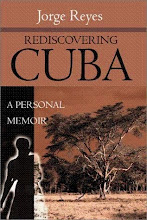
I have been thinking a lot lately about the U.S.-led Cuban embargo and its ability, real or perceived, ultimately to bring about a democratically elected government in Cuba. In my most recent book, a personal memoir that included a visit to Cuba, I hardly touched on the subject. At the time I was writing it I didn't think politics was as important as the personal drama I sought to analyze.

However, since then, many things have occurred that have brought the entire dialogue of Cuba to the forefront (yes, I'm thinking of the Elián soap opera), causing me to change my own personal opinions. Prior to that time, my thoughts were not unlike what the vast majority of Cubans in exile think: With an embargo, Fidel will be history.

I left Cuba when I was 8 years old. Up until my visit, I thought very little of my country. I was too taken by my new adopted nation -- by everything it gave me, by all the opportunities I had. Cuba, to my way of knowing, was a backward nation with a repressive form of government that stifled aspirations, hope and even happiness. The few times I thought about Cuba, I only thought about the bad things: having my hair forcefully trimmed at my elementary school; actos de repudios -- acts of repudiation; the hardships; the hunger.

Why, I thought to myself, would anyone want to go back and visit?

As I grew older, my ideas matured, and my memories became laced with childhood nostalgia. It was Ernest Hemingway who said that memory is hunger. I often heard about the old house in the town in Boniato near the city of Santiago de Cuba. I often heard about my grandmother, now old, with cottony white hair and a face full of wrinkles, who every afternoon sat in the corridor of the house dressed in white cotton petticoats she still made by hand. She often asked any visitors from Miami about me, about my mother, about her other family members whom she hadn't seen in more than 20, then 30 years.

These thoughts, plus the terminal illness that finally consumed my grandmother, prompted me finally to ask my mother and an aunt to go back. They -- especially my mother -- had trepidations about going to Cuba. What were they going to find? What were they expecting to find?

We left Miami on a Friday afternoon and arrived in Boniato at the crack of dawn on Saturday. It took us almost 12 hours to arrive in a country that's only 45 minutes away. By the time we got to our hometown, the three of us were already tired, seeing our country as if in a dream. Cars, buses and horse-drawn carriages made up the traffic of Santiago at that hour.

The people seemed to live under circumstances that were, well, less than favorable. Homes had electricity, but blackouts underscored the strange realities of the peoples' existence. When there was light, it was so faint that everything took on a surreal pale glow that was nothing less than creepy.

Buses were filled to capacity, and the people on the buses usually hung from doors and windows, clinging desperately to each other by the hem of shirts or pants, whatever.

I devoted a very brief chapter to politics in my book. As I said, politics wasn't as important to me as the personal drama I sought to rediscover. And yet the tragedy of the Cuban people as a whole and Cuba's experiment in communism, or Fidelism, cannot be separated -- complex as it may be, sad as it is -- from political undertones.

It was then, on my trip to back, seeing this disaster all about me, that my ideas about Cuba began to change, and quick. The U.S. embargo hurts the people, not those in power. If the ultimate purpose of the embargo is to defeat Fidel by isolating him economically, socially and politically, it has failed in both rhetoric and in practice.

Fidel, 49 years after his revolution, is still there, old and on the brink of death, but he's still there nonetheless using the embargo for his own purposes!

This, to me, is reason enough to scrap this relic of the Cold War and come up with something better., And this should be done not because of Cuban politics but in spite of Fidelism and in spite, even, of the ire this view draws among many well-intentioned Cuban Americans in Miami. Further isolation makes no sense when the time is ripe to bombard Cuba with commerce, information and an influx of new ideas.

I often heard about my grandmother, now old, with cottony white hair and a face full of wrinkles.

All those who with Janus-like face only can look at an either-or situation miss the complexities of the Cuban nation and the countless, slow ways it will eventually turn into a pluralistic, multi-party political system.

I may be naive about my opinions. What I do know, though, is that there is a lot of work to be done in a post-Castro Cuba. The realities of that future demand new, fresh, imaginative ways to bring about a peaceful reconciliation among Cubans.

I don't have all the answers. What I do have is an open mind. Now is the time, more than ever, to breach this gap and cross that 90-mile stretch that to some of us is as wide as the universe. So I wrote in the book: "Go and visit an uncle. An aunt. A grandmother. Honor your past. Crack that barrier that exists. Rediscover yourself. The Cuba of tomorrow belongs to all of us.''

My parents lost Cuba once. Don't let it happen again with this generation.

REDISCOVERING CUBA
(EIGHT YEARS LATER)
As the years have gone by, I'm glad that the main thesis of the book has proven correct, mainly, that the Cuban embargo had been a disastrous foreign policy towards Cuba, and that, coincidentally, it has never much of an embargo. I based this on the fact that the book was written while I was visiting family in Cuba, like countless other Cubans, and with certain conditions I dind't feel I was visiting an enemy country nor that there was much of a tight grip on the symbiotic interchange of ideas between both countries.

Mind you, my trip was not prompted by politics, but by my grandmother's terminal cancer. She had less than six months to live, and I felt that my mother as much as myself had to say goodbye. Who can argue against that? Some tried, but the argument was indefensible. I even presented a copy of the book to Congresswoman Ileana Ross Lehtinen and, in private, she told me she couldn't have argued against something as humane and touching as what I did. In fact, she supported my decision.

And that's exactly the crux of the problem. Most Cubans defy the embargo because their defiance of it makes the difference to a family member back in Cuba- a mother, a father, an uncle, a niece. It makes the difference whether they go to bed hungry, or simply have enough money to take a better forms of transportation to go to school or work, paid for by dollars, of course.

I ask you: if you had a parent or close family member living through his/her days and you were able to go, would you refuse to in political principle? I doubt it. The same goes for any Cuban in similar circumstances.

The game of the old is over and if it isn't, it should.

This is a new generation of Cuban-Americans who are not monolithic in the way we think, in the way we speak, in the way we even think of Cuba. Anyone else who speaks for old cold-war rhetoric is just a demagogue. Deal with Cuba's present political system we must, weather we like it or not. What would be the opposite? Hope for a social and political crisis which will lead to a bloodbath. Personally, I doubt that will ever happen, but that's exactly the policy of many who still defend the wanders of what the embargo has done to cripple Castro's political repression. If anything, it has strengthened it.

I blame this not just on the Cuban exiled community. I equally blame this impassee to the US government less-than creative foreign policy towards the Caribbean island. It has shown a desire to talk tough only during presidential visits to South Florida, but it refuses to even consider diplomatic, respectful dialogue based on a semblance of equality and respect to nationhood. Castro, no fool himself, has sensed this ambivalence and weakness and used it to his benefit. The fact is he remains in power. The fact is that if this embargo had been successful Castro would have been fodder for old newspapers. The fact is we wouldn't be having this conversation, so long in the making.

I may be wrong. I doubt it very much. The effects are so obvious.

19 June, 2008

Mariela Castro's triumph: free sex change surgeries in Cuba.


by Jorge Reyes

There are things in life that never cease to amaze me. Recently I was approached by the editor of a newspaper to consider the possibilities of writing an article about Cuba's latest social and legal policy: the approval of giving transsexuals in Cuba free sex operations for anyone who qualified.

In a country that boasts of having free medical services, this shouldn't have been surprising except for the fact that the type of free medical services that will be provided is nothing less than a sex change surgery and the legal change of identity.

Wow. Is this all?

As of the writing of this, there are already:

28 qualifying diagnosed transsexuals;
19 of whom want to undergo surgery;
8 do not want to undergo surgery, but they want to change their legal identity;
13 have successfully been able to change their names and replace the photo on their identity cards;
7 are waiting approval by the Justice Ministry for their legal changes.


But this is the thing, it gets even stranger still.

The move to legalize such amazing social policy has been strongly supported by none other than Mariela Castro, president Raul Castro's own daughter. Mariela, a sexologist, heads the National Center for Sex Education (CENESEX), and she's not shy about the role she played in bringing about the successful implementation of Resolution 126, as it is known, which was signed into law on June 4 of this year.

As of late, she has openly and publicly criticized Cuba's homophobia and has even apologized for her own family's role in the forceful imprisonment of gays and lesbians in the past. In the 1960's, Cuba would simply incarcerate or send to labor camps anyone suspected of being weak or effeminate. Fast-forward to 2008, and what you will get is a gay and lesbian society that doesn't seem to mince words or live in a half-world of double-truths.

Long, it seems, are the days when Cuban writers, intellectuals or others were simply socially ostracized, arrested or deported to other countries merely for suggesting anything that went against the heterosexual machismo mores of the times. All one has to do is read Reinaldo Arenas's memoirs, novels and short-stories. I won't go into any detail about these literary gems, suffice it to say that when he died of AIDS Mr. Arenas left behind a harrowing first-person narrative of what it was like growing up gay in Castro's Cuba during the 1960's and 1970's. And it wasn't pretty.

Even Fidel Castro gave an equally quoted interview in 1965 where he said "there are no homosexuals in the countryside." By 1992, Castro  seems to have changed his mind.

But how did these changes occur without many people even discussing outside of Cuba remains a mystery. Why in Cuba, of all places, remains an even greater mystery.

What's perhaps odd, to me at least, is that before any substantial social policy takes place, a majority of the populace must have accepted such changes. In less than thirty years (and that's a brief time in a country totally micromanaged by the communist party), homosexuality went from being penalized to something that seems accepted, within limits.

I suppose that lots of credits must be given to Mariela Castro herself and the interest she's taken on behalf of a group of people largely misunderstood. She's said that for many years she tried to change her dad's own views on homosexuality and that he, far from encouraging at first, cautioned her later to be prudent and to continue with her activism.

It's difficult to predict how far these changes will go towards slowly moving away from a monolithic political system, and how much Raul Castro will tolerate.  There could be a political backlash. As a friend of mine from London wrote me in a email, she hopes that these changes are not simply cosmetic in nature and used as a ruse to imprison gays and lesbians later on.

I don't think that's the case; first, the Cuban government, far from being a politically pluralistic society, didn't have to open up a space for Cuba's gay, lesbian, transsexual and trans-gendered community in order to retaliate against them later on. Yet it did and it's curious that while in the past it has lumped members of the GLBT community with political reactionaries, this time it hasn't and, in fact, separated them altogether as a potential political threat.  Don't fool yourselves, it could happen even with Mariela's best intentions.


Cuba's ratification into law of Resolution 126 as well as the striving to fully integrate members of the gay, lesbian, trans-gendered and transsexual community to the forefront of public discourse and legal rights seem to be the most liberal and ambitious of its kind in the Western hemisphere, including its neighbor to the north the United States.  (By the way, Mexico just this week seems to be on the forefront of progressives social policies as well legalizing gay marriages, another one of its kind simply because Mexican society is still dominated by the old prejudices and that equally hypocritical Machismo mentality.)

If Cuba's government continues on this road towards a semblance of pluralism, Raul Castro's Cuba may follow a path unlike any of us had ever expected. Others are very skeptical that this will translate into any form of political openness.  They argue that this is just a little band-aid given to an oozing problem.  It remains to be seen, though, if these changes however slow can also be irreversible. 
Time will tell.  One never knows what's going to happen in Cuba from one minute to the next.