17 December, 2009

What's newsworthy anymore?

By Jorge Reyes

It's been a scandal-filled month. Most of the scandals have nothing to do with corrupt politicians or anything of a boring nature. Every one of these scandals involve sex and celebrities, of course. The most popular of them is, of course, Tiger Woods, the golf player. There are others and they have become equally titilating: the escort turned New York Post columnist, Ashley Dupre, and the state of Nevada, where male prostitution was finally legalized.

It's a shame TV evangelist Oral Roberts passed away this week, otherwise he would have raved and ranted against the promiscuous libertine sexual revolution of our current society. I'd hate to agree with him, but he's partially correct.

First the really juicy story, or the award for the most overrated news report, which is the Tiger Woods scandal. More and more women are coming to the fray claiming to have had tryists with Woods. These ladies have taken great steps to give a lot of details about the where, how, and when. Woods, of course, seems to have an affirmative action quota of sorts: all his mistress either have the same job-- either cocktail waitress, bouncers at clubs, or porn actress-- and he seems to like one type of woman-- white and predominantly blonde, like his wife.

Not sure if this is a joke or not, but his sexual indiscretion has given cause for a Tiger Woods Syndrome, or paranoid wives concerned that their nice, sweet, loving husbands may be having extramarital affairs.

For the sports world of golf and for Woods himself there's a far more serious consequence than all these women claiming to have had sex with him and that is the professional and personal loss of income he might experience in 2010. Advertisers have either dropped him already as in the case of the consulting company Accentura which paid him a reported $7 million a year, or are contemplating dropping him such as A&T. There are others.

Sexier story still is Ashley Dupre, the high price hooker who brought down ex NY governor Eliot Spitzer in 2008. I'm sure that neither Spitzer nor Dupre merit an introduction. When their sexual relationship was discovered, the news media simply saturated the airwaves with their story. The scandal doesn't seem to have affected Dupre's professional advancement. The same cannot be said of Spitzer. Dupre, it seems, has landed a regular advice column in the New York Post called aptly titled “Ask Ashley”. She answers questions close to her heart (and line of work) such as sex, love and relationships. The New York Post is unapologetic about this and seems to be basking in their own business savvy.

It's ironic, of course, that Dupre hasn't been one of Woods alledged mistress. In such closed-off world of high price prostitution and rich men, everyone seems to know each other.

But you never know. The Tiger Woods story is far from over and Ashley Dupre could have a few surprises in store for us. Time will tell.

But Woods and Dupre are not the only sexual creatures making headlines these days.

Ever heard of the Shady Lady Ranch? If you think it's some sort of religious cult a la Oral Roberts, you are wrong. It's actually a legal brothel in Nevada whose current owner, Bobbi Davis, must be in heaven these days-- figuratively speaking. You see, state officials in Nevada have finally legalized male prostitution, a profession illegal up until this point.

Female prostitution is nothing new in Nevada. It has been legal in that state since 1971. Prostitution is nothing new anywhere, of course, it has been part of every culture in any period of history. But male prostitutes in Nevada were out of luck since they were barred from this old (and often lucrative) profession due to a specific health law that called for prostitutes to have frequent cervical medical checkups for sexual transmitted diseases. Cervical medical checkups can only be done on women. But with the approval of urethra testing, which can be done on men, the male ban against male prostitution was lifted, and lo and behold, males can finally enter this profession hitherto blocked from them.

I'd dare say that soon we will have our very own infamous male Dupre. Watch for it.

Asides from the scandalous nature of any of these stories currently being disseminated as substantial news reports, I tend to think that none of them merit the level of media scrutiny that they have received. Sex sells and that's been proven, but respectable media organizations should know better.

As a nation we have lost all sense of proportionality, caring very little for degrees or levels of privacy which is at the core of the Tiger Woods scandal and many others. In Woods case, he is a public figure and the public needs to scrutinize the actions of its leaders and heroes, but I tend to think that there is a limit to how much we need to know, particularly if this involves a person's stupid actions which only concern his wife and his pozee of women, and then us, the public. Yet, news organizations have become saturated with his story and not one of them has refused to give fair time to the ever-growing number of women alleging they were his mistresses, regardless of whether their stories are true or not. Even if true, their stories on TV or the print media should have been limited in nature.

Many people in our society have become exhibitionist and we, in turn, we have become voyeuristic. Anyone, and I mean anyone, can claim to have something of any substance to say and we give them plenty of airtime, no matter how foolish and off the wall their claims might be.

The scandalous, I guess, has become the substantive and as a people we can't tell the difference any longer. And that, my friends, is a problem.

14 December, 2009

Barack Obama's Nobel Prize Oslo Speech


President Barack Obama's Nobel Prize Speech in Oslo has been both hailed and criticized due to its seeming contradictory nature. I take a different view and feel that there is nothing contradictory about his speech, about his vision and plan for peace, nor about the tactics he and his administration are willing to take at a time when he has sent an additional 30,000 troops to war-torn Afghanistan.

The only critique I have is the timing. After all, as of the writing of this entry Obama has been in office for only nine months.

His speech, a fine lesson in history about the relationship between war and peace, action vs. inaction, understands the complexities of the world, the ambitious nature of some nation-states and the role the US should take in order to tackle international threats that affect us all.

Unlike Bush, Obama didn't said that there was an "axis of evil" that must be fought unilaterally increasing our presence and imperial power abroad; instead, Obama chose to elucidate his belief that evil was a real presence in the world and it must be fought by engaging in a two-step process: engagement and sanctions with rogue nations.

Certain members of the media have referred to the seeming contradictions between the man and his words; between the man and his presidential actions; between his rhetoric and pragmatism.  Some have even written that engagement and sanctions is a failure that hasn't worked in the past.  In fact, many nation-states such as North Korea are so isolated that engagement is sure to result in failure. At other times, regime change has proven to be almost impossible, short of war. And international sanctions has proven very difficult to enforce.

Critics have gone on to say that in other areas, Obama has done all the right talking but failed to bring about results-- from climate change to nuclear arms control, from Iran and North Korean's atomic ambitions to US sanctions in Sudan. Human rights violations continue to exist in many parts of the world. The Israelis and Palestinians are still deadlocked over a two-state solution. And not to be forgotten, many still remember how Obama ducked meeting with the Dalai Lama in order to avoid a conflict with China.

Rightfully so, the world is not any less dangerous than it was yesterday; it is not any more peaceful because of Obama's personal vision, leadership, or policies. But what the speech did highlight is that engagement with the world continues to be fraught with real dangers and peace as much as war are never mutually exclusive.

Of all the people who liked Obama's speech was Sarah Palin who told USA Today she particularly liked his references to just war and the fallen nature of mankind.

As I wrote, the only problem that I see with this prize is the obvious fact: Obama has been president for only nine months and already he's been hailed as a modern day Gandhi and Martin Luther King, both leaders whom he mentioned throughout his speech. Very little time has been given to test the effects of an Obama Policy which is still in its infancy. But in all honesty, I don't think that at this point the Nobel Prize will be judged so much by its effects as much as by Obama's commitment to the basic principles he read, and for that reason alone I don't think a better political leader could have been chosen.


09 December, 2009

A Modest Proposal: execute gays and, God, save us from perdition!

by Jorge Reyes

No discussion is veiled in more hypocrisy but virulent attacks than the issue of gay-rights.  By “gay” I also include lesbians and transgendered people.  The attacks are usually more virulent if it is faulted for societal problems, such as the cause of a high divorce rate, pedophilia or bestiality even.  Never mind that gay men and women can lead happy, long-lasting and healthy relationships and partnerships.  Never mind that a sicko can be either straight or gay.  

Which brings me to the African state of Uganda, where an imperialistic war of religious values is taking place. 

Here's the scoop. 

On October 15, the state of Uganda introduced the Anti-Homosexuality Bill of 2009, that creates harsher penalties against homosexuals, including the death penalty. 

The provision for capital punishment is for “aggravated homosexuality” which is defined as having gay sex with disabled people or anyone under 18, or when the accused is HIV positive.

Anti-gay rhetoric is nothing new in Uganda, or many African countries.  What's ironic about this bill is that it has the strong backing of American Christian evangelical groups, many of whom are involved in the so-called “conversion” movement that seeks to make homosexuals straight. 

The whole assorted mess begins back in March of 2009, when Family Life Network of Uganda invited three American religious-affiliated groups to a symposium about homosexuality.  These groups are Abiding Truth Ministries, Exodus International, and the International Healing Foundation.  The symposium's main agenda was to effectuate the political meddle necessary to back up the drafting of this bill with none of the political correctness and coded language they usually use back home in the United States. 

The usual rhetoric was used, of course, and it proved to be as lively.  Scott Lively, who represented Abiding Truth Ministries, compared homosexuality with child abuse, pedophilia and bestiality.  Not to be forgotten, Lively also blamed gays for Hitler's rise to power in the 1930's.  He was invited to give a speech in the Ugandan Parliament.  

Fast-forward all that fervent religiosity and you get to the end of the tape: the Anti-Homosexual Bill of 2009.  

But there others.  Among them is Martin Ssempa.  If the name doesn't ring the bell, Ssempa is a pastor who in the past has shared the same bully pulpit at Saddleback Church with Rick Warren, famous for his bestseller the “Purpose-Driven Life,” and a man who believes that being gay is unnatural.  

Warren distanced himself from Ssempa in 2007, but has never admonished Ssempa's anti-gay views, despite the fact that in the United States he is very careful to give politically correct answers when pressed on the subject of homosexuality.  When questioned by Newsweek about this bill and Ssempa's connection to it, Warren simply argued that every person has a right to live his or her life any which way he or she wants, but here's where the double-talk was at its finest, he concluded that as a pastor it wasn't right for him to interfere in the political process of any country. 

Is he kidding?  When has any religious denomination, at whatever period of history, not interfered with the internal affairs of a foreign country?

Some churches have been eerily quiet about this bill.  Other churches, which historically have been on the forefront of social activism have indeed criticized the bill, calling for long prison sentences instead of the death penalty. 

Which brings me to my modest proposal; a proposal that goes back to the 17th century.

In the 1790 Jonathan Swift wrote one of the most ironic and sarcastic essays that called for the murder and cannibalism of poor children.  What's the point, he argued, of indiscriminate birth by poor women  when these children grow up to be nuisances to the aristocracy? These days we call these poor women “welfare queens.”  Better to be merciless, but swift, and end what's plaguing society.  

In my own sarcastic modest proposal of 2009, I call upon all these US evangelists and political spin-doctors to preach at home what they preach in foreign soils.  I implore upon them to draft a US call-to- action that calls for the outright death of gay men in order to end the AIDS epidemic.  By killing gay men, we will also reduce the high rate of divorce, which is the single most cause of the destruction of our Judeo-Christian civilization.  But, of course, why stop here?  Why not stone to death women suspected of infidelity, cut off the right hand of most men who masturbate, enslave black people, and call upon god's grace to bring about a worldwide plague against infidels and terrorist nations?  The payoff?  A perfect Christian world.   

Call it what you want, but religion at its worst is a genocidal virus.  At its best, it can be anything anyone wants it to be, which is not that good either.  Either way, it becomes a double-edge sword in the hands of dangerous people.  As many Americans were reminded in 9/11, religion is still at war in many parts of the world.  Imagine if this religious genocide finds fertile ground in less homogeneous countries such as in Sudan.   

Of course, religion has never made much sense to begin with, but its message taken too far is one to be vigilant about. 

03 December, 2009

The Left and the Right, and the in-between

By Jorge Reyes

As a civil libertarian, I've always been fascinated by the political and judicial realignment that often occurs in our culture. Some sociologists have written that these changes often mirror the coming together of new coalitions due to generational changes.

This is nothing new, of course. The realignment can be of short duration. Other times it can have lasting effects.

Generational changes often also translate how the culture wants to define and redefine the role of government, the role of our institutions, the role of private interchanges even.

The next few months the Supreme Court will decide a couple of cases that some have observed are signs of a realignment between conservative, left-wingers, libertarians and business groups.  Talk about an odd group!

Conservative groups such as the Heritage Foundation, the American Civil Liberties Union, the CATO institute, the Federalist Group, among others, have all written friend of the court briefs critical of the role of government's tough-on-crime policies.

Edwin Meese III, who was the attorney general under Ronald Reagan and who in the past has called the ACLU “a criminal body”, has now joined forces with those same groups combating what he feels is the increasingly dangerous vagueness of federal law and its intrusive role on the states. Meese is now a fellow of the Heritage Foundation.

The Heritage Foundation, one of the most conservative advocacy groups, has underscored the fact that currently there are 4,400 criminal offenses in the federal code so vague that any of us could practically be charged with a federal crime. As an example, under federal law it is a crime to give a false weather report. Can you imagine all those TV weatherman?

Three Supreme Court cases exemplify this political and judicial realignment. One deals with the meaning and intent of Federal Law 1346 or “honest services” fraud as it is known, where there is suspicion of dishonesty or fraud that deprives victims of an intangible right to honest services that may not be that apparent. And that's the problem, what are honest and intangible services? As interpreted in the past, honest services comes into play when someone either in the public or private sector acts in a dishonest manner in his or her business dealings. Evidence may not be tangible to prove fraud, such as when victims as cheated or bilked out of moneys fraudulently.

Justice Antonin Scalia has sharply criticized this “honest services” law as vague and overbroad, and a break from history and criminal precedent. Writing in February he stated that “it seems to me quite irresponsible to let the current chaos prevail."

In effect as some have argued, under this law Cardinal Roger Mahoney, from the archdiocese of Los Angeles, could be charged with the commission of a crime by harboring pedophile priests or by simply moving them around to another parish in order to protect the churche's interests. In Bonita Springs, Florida, a man named Samir Cabrera was convicted of six counts of wire fraud using the “honest services” approach when prosecutors made a convincing claim that Cabrera bought two properties at market value and then flipped them at a higher price failing to disclose his earnings to investors but pocketing the difference.

Other cases to be noted is Alvarez v. Smith and United States v. Comstock.

At issue in Alvarez is whether or not the state of Illinois can hold on to a seized property indefinitely. At issue in Comstock, which will be heard in January, is whether people convicted of a sexual offense can be held in confinement after they have served their criminal sentences.

I love it when people change their views across a wide spectrum of political, legal and cultural views. A law that remains in the book from time immemorial serves no one any purpose. A political system that becomes monolithic and representative of a particular brand of ideology, be it from a social or financial group to the exclusion of others, tends to fracture and turn into itself, churning out five-second sound-bytes and cliques as opposed to values. And good values is what everyone, of any political spectrum, seems to want.

The main problem as I see it is that we're too used with the labels of Left and Right and have become afraid and even apologetic about thinking outside the box of what's expected. However, it much more fulfilling recognizing that one has a right to think differently and independently. Lest we forget, thinking differently and often radically different is an American value, one of its most cherished. What we learn, who we are, what we want to do and leave behind as a legacy, is never a commandment writ in stone forever more. Unfortunately, it is much easier to live with cliques and mass-produced ideas; we've gotten used to the easily palatable.

The Right has a productive history criticizing the tendency in all of us to use the power and stick of the state to create results. The Left has an equally rich history criticizing entrenched, pro-rich monopolies to the exclusion of the life and struggles of everyday men or women. In between, there is such diversity of opinions that labels such as pro-life or pro-abortion, pro-gay or anti-gay, theist or atheist become non-issues.

We have forgotten to listen and to learn from one another-- the left, the right, or the middle-way.

That's a shame, and one the greatest problems we face as a nation for there is much to learn from even new ideas we consider anathema to our values.

27 November, 2009

Unemployment and "the end of work"

by Jorge Reyes

While reading a local paper not long ago, I was struck by a staggering report: in October 2009 Miami-Dade's unemployment rate neared 12%. These numbers, of course, may be higher since it doesn't take into account people who no longer qualify for unemployment benefits, have stopped looking for work, or simply are working in seasonal jobs.

As reported, Miami-Dade County’s unemployment rate in October increased by 0.4 percent compared to September (11.4) and an increase of 5.2 percent compared to October 2008. For the State of Florida, the unemployment rate was 11.2 percent while for the United States it was 9.5 percent.

While some experts boast of economic recovery, others simply are warning that the worse is yet to come. Somewhere in the middle are those who think that this work malaise is representative of something bigger happening in our workforce and culture.

The End of Work: The Decline of the Global Labor Force and the Dawn of the Post-Market Era by American economist Jeremy Rifkin, and published in 1995 by Putnam Publishing Group.

Written in 1995 (way before the current worldwide financial crisis), Rifkin contended that worldwide unemployment would increase as the information technology eliminated tens of millions of jobs in the manufacturing, agricultural and service sectors. According to Rifkin, automation had devastating effects on blue-collar, retail and wholesale employees.
Coincidentally, the same could not be said of corporate managers who continued to reap the benefits of the high-end global economy.

Rifkin, of course, doesn't prophesy such doomsday scenario without coming up with possible solutions. He suggests that new jobs would be created by the growth of what he calls a "third sector", or voluntary and community-based service organizations that would create new jobs with government support. These service organizations would overhaul how the government tries to do business with the workforce by implementing a massive restructuring of socially-beneficial programs, such as rebuilding decaying, crime-infested neighborhoods, among others. Rifkin would finance this "third-sector" by cutting down on the military budget, creating a "value added tax" and by redirecting federal and state funds to provide a "social wage" instead of welfare payments to third-sector workers.

Rifkin suggests that we move beyond the delusion of retraining for nonexistent jobs. He urges us to begin to ponder the unthinkable-to prepare ourselves and our institutions for a world that is phasing out mass employment in the production and marketing of goods and services.

Redefining the role of the individual in a near worker-less society is likely to be the single most pressing issue in the decades to come.

Fresh alternatives to formal work will need to be devised. New approaches to providing income and purchasing power will have to be implemented. Greater reliance will need to be placed on the emerging "third sector" to aid in the restoration of communities and the building of a sustainable culture.

Which brings me back to my opening statement. The current unemployment rate and the shift in workforce trends were caused by many reasons, main one being the mortgage crisis of 2007 among others. Job growth in any sector is always a good thing, but missing among all these quantifiable statistics is the fact that there is a permanent, underlying issue which is often not addressed by government figures-- that these low paying, seasonal or short-term jobs do not contribute to the growth and reemergence of an economically viable middle class, but is adding to its continual corrosion.

03 July, 2008

Boxing: Brutal Sport. Ritual Dance.


by Jorge Reyes

Not long ago, I was talking to a friend of mine who made a startling revelation: she was a fan of boxing. Not only was I in shock and didn't believe her, though she was serious. And not only was she serious, but she seemed taken aback by my lack of respect.
Since my chauvinistic mind can't understand how a female can also be an avid lover of boxing, I had a hard time believing her until she started to talk to me, in great detail, about her hobby which includes hosting an active boxing web-site visited by thousands of people worldwide.  She's into boxing, what can I say, and my admiration grew.

Curious, I had to find out more and I started to immediately reading up on boxing, or the "gentle sports" as it is ironically known.

BOXING: Brutality?  or reflection of life?

The boxing ring displays an art form that is both brutal and real, yet ideal and delicate-- the perpetrator is as much in need of the victim (the loser) as much as the victim needs the perpetrator (the champion). The fighters exemplify the unleashing of energy at full display which, at the same time, shelters them from the act of law, mores or distributive justice. It makes the spectators, us, witness to an act normally too raw and visceral to accept within polite society. The fighter, though, stands and defends his title with the same act of transgression expected of the most sadistic murderer; even while he is both a potential victim or a potential winner, at least temporarily or until his youth and stamina can withstand the punishment-- both physical and mentally. It is his desire to crush the Other, own him until the end of the match and often beyond, and then somewhat dismiss him as a volitional individuals because the act of winning is also the act of ownership.

Boxing is similar to the predatory act of survival; transgressive, yes, which is justified as legitimate only within the perimeters of its designated art medium-- the boxing ring. Outside of it, it is nothing short of predatory violence.  The boxing ring, then, becomes an inviolable self-enclosed world above and beyond anything or anyone. It doesn't answer to anyone but the act of boxing itself, and the two fighters. They, in turn, answer to no one except themselves. The spectators, us, in turn can only respond in a sort of voyeuristic act of expectation a ritual dance between two people who are locked in a duel to one goal-- total defeat or total championship.

Outside References:
Bragging Rights Corner
David Diaz vs. Manny Pacquiao

28 June, 2008

End the Cuban Embargo


by Jorge Reyes

I have been thinking a lot lately about the U.S.-led Cuban embargo and its ability, real or perceived, ultimately to bring about a democratically elected government in Cuba. In my most recent book, a personal memoir that included a visit to Cuba, I hardly touched on the subject. At the time I was writing it I didn't think politics was as important as the personal drama I sought to analyze.

However, since then, many things have occurred that have brought the entire dialogue of Cuba to the forefront (yes, I'm thinking of the Elián soap opera), causing me to change my own personal opinions. Prior to that time, my thoughts were not unlike what the vast majority of Cubans in exile think: With an embargo, Fidel will be history.

I left Cuba when I was 8 years old. Up until my visit, I thought very little of my country. I was too taken by my new adopted nation -- by everything it gave me, by all the opportunities I had. Cuba, to my way of knowing, was a backward nation with a repressive form of government that stifled aspirations, hope and even happiness. The few times I thought about Cuba, I only thought about the bad things: having my hair forcefully trimmed at my elementary school; actos de repudios -- acts of repudiation; the hardships; the hunger.

Why, I thought to myself, would anyone want to go back and visit?

As I grew older, my ideas matured, and my memories became laced with childhood nostalgia. It was Ernest Hemingway who said that memory is hunger. I often heard about the old house in the town in Boniato near the city of Santiago de Cuba. I often heard about my grandmother, now old, with cottony white hair and a face full of wrinkles, who every afternoon sat in the corridor of the house dressed in white cotton petticoats she still made by hand. She often asked any visitors from Miami about me, about my mother, about her other family members whom she hadn't seen in more than 20, then 30 years.

These thoughts, plus the terminal illness that finally consumed my grandmother, prompted me finally to ask my mother and an aunt to go back. They -- especially my mother -- had trepidations about going to Cuba. What were they going to find? What were they expecting to find?

We left Miami on a Friday afternoon and arrived in Boniato at the crack of dawn on Saturday. It took us almost 12 hours to arrive in a country that's only 45 minutes away. By the time we got to our hometown, the three of us were already tired, seeing our country as if in a dream. Cars, buses and horse-drawn carriages made up the traffic of Santiago at that hour.

The people seemed to live under circumstances that were, well, less than favorable. Homes had electricity, but blackouts underscored the strange realities of the peoples' existence. When there was light, it was so faint that everything took on a surreal pale glow that was nothing less than creepy.

Buses were filled to capacity, and the people on the buses usually hung from doors and windows, clinging desperately to each other by the hem of shirts or pants, whatever.

I devoted a very brief chapter to politics in my book. As I said, politics wasn't as important to me as the personal drama I sought to rediscover. And yet the tragedy of the Cuban people as a whole and Cuba's experiment in communism, or Fidelism, cannot be separated -- complex as it may be, sad as it is -- from political undertones.

It was then, on my trip to back, seeing this disaster all about me, that my ideas about Cuba began to change, and quick. The U.S. embargo hurts the people, not those in power. If the ultimate purpose of the embargo is to defeat Fidel by isolating him economically, socially and politically, it has failed in both rhetoric and in practice.

Fidel, 49 years after his revolution, is still there, old and on the brink of death, but he's still there nonetheless using the embargo for his own purposes!

This, to me, is reason enough to scrap this relic of the Cold War and come up with something better., And this should be done not because of Cuban politics but in spite of Fidelism and in spite, even, of the ire this view draws among many well-intentioned Cuban Americans in Miami. Further isolation makes no sense when the time is ripe to bombard Cuba with commerce, information and an influx of new ideas.

I often heard about my grandmother, now old, with cottony white hair and a face full of wrinkles.

All those who with Janus-like face only can look at an either-or situation miss the complexities of the Cuban nation and the countless, slow ways it will eventually turn into a pluralistic, multi-party political system.

I may be naive about my opinions. What I do know, though, is that there is a lot of work to be done in a post-Castro Cuba. The realities of that future demand new, fresh, imaginative ways to bring about a peaceful reconciliation among Cubans.

I don't have all the answers. What I do have is an open mind. Now is the time, more than ever, to breach this gap and cross that 90-mile stretch that to some of us is as wide as the universe. So I wrote in the book: "Go and visit an uncle. An aunt. A grandmother. Honor your past. Crack that barrier that exists. Rediscover yourself. The Cuba of tomorrow belongs to all of us.''

My parents lost Cuba once. Don't let it happen again with this generation.

REDISCOVERING CUBA
(EIGHT YEARS LATER)
As the years have gone by, I'm glad that the main thesis of the book has proven correct, mainly, that the Cuban embargo had been a disastrous foreign policy towards Cuba, and that, coincidentally, it has never much of an embargo. I based this on the fact that the book was written while I was visiting family in Cuba, like countless other Cubans, and with certain conditions I dind't feel I was visiting an enemy country nor that there was much of a tight grip on the symbiotic interchange of ideas between both countries.

Mind you, my trip was not prompted by politics, but by my grandmother's terminal cancer. She had less than six months to live, and I felt that my mother as much as myself had to say goodbye. Who can argue against that? Some tried, but the argument was indefensible. I even presented a copy of the book to Congresswoman Ileana Ross Lehtinen and, in private, she told me she couldn't have argued against something as humane and touching as what I did. In fact, she supported my decision.

And that's exactly the crux of the problem. Most Cubans defy the embargo because their defiance of it makes the difference to a family member back in Cuba- a mother, a father, an uncle, a niece. It makes the difference whether they go to bed hungry, or simply have enough money to take a better forms of transportation to go to school or work, paid for by dollars, of course.

I ask you: if you had a parent or close family member living through his/her days and you were able to go, would you refuse to in political principle? I doubt it. The same goes for any Cuban in similar circumstances.

The game of the old is over and if it isn't, it should.

This is a new generation of Cuban-Americans who are not monolithic in the way we think, in the way we speak, in the way we even think of Cuba. Anyone else who speaks for old cold-war rhetoric is just a demagogue. Deal with Cuba's present political system we must, weather we like it or not. What would be the opposite? Hope for a social and political crisis which will lead to a bloodbath. Personally, I doubt that will ever happen, but that's exactly the policy of many who still defend the wanders of what the embargo has done to cripple Castro's political repression. If anything, it has strengthened it.

I blame this not just on the Cuban exiled community. I equally blame this impassee to the US government less-than creative foreign policy towards the Caribbean island. It has shown a desire to talk tough only during presidential visits to South Florida, but it refuses to even consider diplomatic, respectful dialogue based on a semblance of equality and respect to nationhood. Castro, no fool himself, has sensed this ambivalence and weakness and used it to his benefit. The fact is he remains in power. The fact is that if this embargo had been successful Castro would have been fodder for old newspapers. The fact is we wouldn't be having this conversation, so long in the making.

I may be wrong. I doubt it very much. The effects are so obvious.

19 June, 2008

Mariela Castro's triumph: free sex change surgeries in Cuba.


by Jorge Reyes

There are things in life that never cease to amaze me. Recently I was approached by the editor of a newspaper to consider the possibilities of writing an article about Cuba's latest social and legal policy: the approval of giving transsexuals in Cuba free sex operations for anyone who qualified.

In a country that boasts of having free medical services, this shouldn't have been surprising except for the fact that the type of free medical services that will be provided is nothing less than a sex change surgery and the legal change of identity.

Wow. Is this all?

As of the writing of this, there are already:

28 qualifying diagnosed transsexuals;
19 of whom want to undergo surgery;
8 do not want to undergo surgery, but they want to change their legal identity;
13 have successfully been able to change their names and replace the photo on their identity cards;
7 are waiting approval by the Justice Ministry for their legal changes.


But this is the thing, it gets even stranger still.

The move to legalize such amazing social policy has been strongly supported by none other than Mariela Castro, president Raul Castro's own daughter. Mariela, a sexologist, heads the National Center for Sex Education (CENESEX), and she's not shy about the role she played in bringing about the successful implementation of Resolution 126, as it is known, which was signed into law on June 4 of this year.

As of late, she has openly and publicly criticized Cuba's homophobia and has even apologized for her own family's role in the forceful imprisonment of gays and lesbians in the past. In the 1960's, Cuba would simply incarcerate or send to labor camps anyone suspected of being weak or effeminate. Fast-forward to 2008, and what you will get is a gay and lesbian society that doesn't seem to mince words or live in a half-world of double-truths.

Long, it seems, are the days when Cuban writers, intellectuals or others were simply socially ostracized, arrested or deported to other countries merely for suggesting anything that went against the heterosexual machismo mores of the times. All one has to do is read Reinaldo Arenas's memoirs, novels and short-stories. I won't go into any detail about these literary gems, suffice it to say that when he died of AIDS Mr. Arenas left behind a harrowing first-person narrative of what it was like growing up gay in Castro's Cuba during the 1960's and 1970's. And it wasn't pretty.

Even Fidel Castro gave an equally quoted interview in 1965 where he said "there are no homosexuals in the countryside." By 1992, Castro  seems to have changed his mind.

But how did these changes occur without many people even discussing outside of Cuba remains a mystery. Why in Cuba, of all places, remains an even greater mystery.

What's perhaps odd, to me at least, is that before any substantial social policy takes place, a majority of the populace must have accepted such changes. In less than thirty years (and that's a brief time in a country totally micromanaged by the communist party), homosexuality went from being penalized to something that seems accepted, within limits.

I suppose that lots of credits must be given to Mariela Castro herself and the interest she's taken on behalf of a group of people largely misunderstood. She's said that for many years she tried to change her dad's own views on homosexuality and that he, far from encouraging at first, cautioned her later to be prudent and to continue with her activism.

It's difficult to predict how far these changes will go towards slowly moving away from a monolithic political system, and how much Raul Castro will tolerate.  There could be a political backlash. As a friend of mine from London wrote me in a email, she hopes that these changes are not simply cosmetic in nature and used as a ruse to imprison gays and lesbians later on.

I don't think that's the case; first, the Cuban government, far from being a politically pluralistic society, didn't have to open up a space for Cuba's gay, lesbian, transsexual and trans-gendered community in order to retaliate against them later on. Yet it did and it's curious that while in the past it has lumped members of the GLBT community with political reactionaries, this time it hasn't and, in fact, separated them altogether as a potential political threat.  Don't fool yourselves, it could happen even with Mariela's best intentions.


Cuba's ratification into law of Resolution 126 as well as the striving to fully integrate members of the gay, lesbian, trans-gendered and transsexual community to the forefront of public discourse and legal rights seem to be the most liberal and ambitious of its kind in the Western hemisphere, including its neighbor to the north the United States.  (By the way, Mexico just this week seems to be on the forefront of progressives social policies as well legalizing gay marriages, another one of its kind simply because Mexican society is still dominated by the old prejudices and that equally hypocritical Machismo mentality.)

If Cuba's government continues on this road towards a semblance of pluralism, Raul Castro's Cuba may follow a path unlike any of us had ever expected. Others are very skeptical that this will translate into any form of political openness.  They argue that this is just a little band-aid given to an oozing problem.  It remains to be seen, though, if these changes however slow can also be irreversible. 
Time will tell.  One never knows what's going to happen in Cuba from one minute to the next.

22 May, 2008

What is the "self"?


by Jorge Reyes

As a writer, I have always tried to differentiate the private/personal from the public. Of course, how can one make such distinctions? I always thought that the personal stayed personal, while the public was always public.

These days, my ideas are not as clear-cut. What is private anymore when we have at our disposal the ability to hack into some of the most personal parts of a person's self? What is public when our discussions so often take on the hue of the personal histories. Even our candidates for public office all speak with the vanity of that landscape called the personal, which only serves to exclude all others landscapes.

As a writer, I also spend endless hours doing next to nothing; daydreaming mostly. I draw upon a rich, weird, and largely unchartered territory known as the human psyche. Characters, places, and people from the past all fight for dominion in this no man's land of memories. I extract and extrapolate from each (public/private; conscious/unconscious; real/imagined) a world and the results are unlike any I first set out to remember. Writing, like witchcraft, is a magic deception into a wonderland of dreams. But, oh, can those dreams be powerful, too!

I don't know how the once well-divided worlds between the public/private crashed in upon itself. But reading a draft of old poems I wrote and which is intended for publication sometime in the future titled Day's Night, I began to wonder. The poems were all written in the summer and winter of 2003. The poems are thematically connected to love and the poems are based on what, at the time, I considered to be a really bad personal relationship. With the power of hindsight, I now know what it was not: a relationship; it was just an attempt, however futile, at believing in the transformative power of love, though in reality it was a forceful attempt on my part to believe it was about love. In fact, it wasn't much of a relationship either.

The poems are morbid, dark, dense. As I wrote in an introduction I had written at the time in 2003, the poems seemed to have been written by someone I didn't know who it was. It didn't seem to be. On the other hand, how I felt the dark, energetic prose that transmogrified into a faint recollection and which, now in 2008, is just as powerful. Perhaps the prose seems powerful to me because I wrote it. Perhaps the prose seemed powerful, irrespective of the fact that I had written it. I know this: reading the poems even at a cursory, safe distance is still disturbing and the poems crawl under my skin. I feel the pain because it was a visceral, primal pain; the type that can have long-lasting repercussions; the type we all recognize as transcending beyond the danger zone and into areas unknown to the human psyche.


Not to dwell in melodrama, but a part of me had died. I was turning into someone else.

Suddenly, I was aware that there are no fine answers that can divide the personal from the public. If I can still distill from the experiences of years past something that can still speak to me, or to someone else, then the poems are as much a part of my private self as it is of yours, and the fictive separation between you and I drop.

I know I wrote the poems, but they could have been written by anyone else and they still would have been as powerful. Is that why, I wonder, there are so many references to "the other" or to "the stranger" in the poems? Is that why I don't recognize the person who may have written them?

And yet, I wanted to leave something of lasting-effect that marked those days; something I could go back to despite the years; something that could describe in concrete terms the emotions I was feeling exactly as I was feeling them. Is that what I meant when I wrote the following?


"I’ve been asked to write whatever comes to mind, mainly
The memories I still hold from these last two years, from the morning I
Met you, sometime in August, until the night I left you, a few months
Apart, from the first few days when we were dating to the last
few days when with such detestation it ended,

before I forget, before I lose interest, before I stop to care
examining the slow, ambling steps I made to the secured
cushion of death’s inevitable addiction, and while I’m still drunk
with my past and while I still want to remember, I’ll do it!
I’ll tell you!
Before I forget. Of course.
I'll tell you how I felt."


I think that's what I attempted to do which is something many of us attempt to do as well. Remembrance of things past? to quote Proust?

Most of the lives we lead are very similar in substance and if not because of our personal histories, they probably would be lived in similar ways. We project upon an outer reality something which is not necessarily a strange response to an inner feeling. It is, I think, something very much a part of us; it is us because it is also within. The personal and the public becoming just syntax of the same principle.

Yet, those poems resurfaced and I felt as if I'd been hit on the face by something unexplainable. The past also became the present. It wasn't so much the particulars of the poems, but the force that emanated from them-- not necessarily a good force. I was confronted with a naked truth, a naked reality, and a reality principle that competed with other principles and all of them went off into different directions without a compass, without a guide, without anything, really. I was victim and perpetrator of a bad relationship, mostly self-made, as much as a love torn freak decrying being in the wrong place at the wrong time and meeting someone I ended up hating passionately. From there, the accidentals of time and place became part of my destiny. I created it as much as I shunned it. But I created it all, whether I want to admit to it or not, and today it is part of who I am, poems and all.

Most of what we consider accidentals turn out to be life-changing circumstances, to our dismay at times to our joy at other times. The private, as much as any belief system, is just the imagination seeking to find a venue of purpose within and without. The public then becomes a much more real place than I hitherto imagined. It is how we fit the pieces of the puzzle together that makes the particulars seem so unique and how the public, you and others, can begin to feel sympathy for others. It is this same dualism that has supported some of our most cherished beliefs.

Not coincidentally, I've postponed the publication of Day's Night for almost five years. Has this been an unconscious act of self-preservation? I often wonder about that one as well.

So, where is the private? It is out beyond, somewhere, out there. It doesn't begin at the point of a personal cognition, but at the point of recognizing that there is a world out there independent of us.  The private has become public, though they remain as separate as ever.

25 December, 2007

How Christianity saved paganism


by Jorge Reyes

We're so pagan and don't know it. 

I write this essay close to the December holidays, a time that most of us celebrate what we call Christmas, a holiday that to some is infused with meaning and symbolism, and for  others it is nothing more than a nice secular holiday season.

This time of the year, though, is one of the most venerated and cherished times ever.  It is a time when the days grow shorter and when we become very nostalgic.  It is also a time when we like to be at our most magnanimous; engaging in benevolence; shunning avarice, hypocrisy, and egotism-- at least for the time being. 
Never mind that's how we like to think of ourselves, even if we go back to our old selves come January.

 But there's more to this sense of altruism than meets the eye.
What drives us all to this feeling of goodness is, perhaps, that this is one of the oldest and most ritualized times celebrated by many, many cultures as far back as civilization, much farthest back than our own Christian belief in the birth of Jesus of Nazareth. 
The winter holidays are a special type of holidays, and pagans as much as us moderns are fully aware.  Something changes in the air, and we sense it.  There's nothing supernatural about this.  It just is.  You see, this is the only time in the year when the days get shorter and there seems a sad, nostalgic, and spirited desire to see life renewed all around us, light winning out against the forces of darkness.

This is the time of the year when the earth is farthest from the sun, days becoming cooler. This is the time, not accidentally, when throughtout the world, many cultures consider this time of the year the saddest. And, the closer it gets to December 22 or thereabouts, the closer we tend to think of life and death. It is a time when our own ancient brethens sought to win the war against darkness, as they slowly saw how light receded into a mere backdrop laden by heavy, grey clouds, and how our friend the sun simply seemed to recede ever more from us; birds chirping with a language as rich in mystery as ancient music; but it was a sad music; with a tenor that portended to a e future when life, once again, would burst with light for us all-- ourselves, our families, and our community.

And so it was, that to early Christians, Jesus Christ, the redeemer of the world, was born on this day to save us all from the palling curtains portending death and into life. It was life born without sin, from a virgin woman; unsoiled and impregnated by mortal life. Can any of us say the same about our own birth, and death? Can nature? Can the cycle of the ever receding light say the same? for it was nothing short of a miracle for the sun to be recycled into something new, better perhaps, and into a new year.

There are four points in our calendar each equally divided by what's known as the solstice and the equinox. The equinox is the time of the year when the earth circling in its own axis in a sort of oval is at a point most centered from the sun in which all days are equal in length. This often happens on March 21 and September 23. The other time of the year, the most exquisite as far as symbolisms, is the winter solstice. During the solstice, the earth still going around in an ellipse, an oval, is farthest from the sun. This often happens on June 21 and December 22. As I wrote, this is the time when days get shorter. This is the time when Jesus of Nazareth, according to legend, was also born. And this is the time when other religious saviors were born as well, including Mithras, a god of very ancient and pagan belief.

Mithras, like Jesus, was also born of a virgin woman on December 25. In Rome, when the Romans tolerated all religious cults, a temple dedicated to Mithras had the following saying at its entrance: "And thou hast saved us by shedding the eternal blood."

The mythical Jesus comes from many traditions, all ancient and pagan in origin. From the years 4 A.D. on, Jesus is depicted with a lamb on his shoulders. The same was depicted of Athens as far back as 570 B.C. Jesus and his mother, Mary, were also depicted as "Madonna and Child", just as Isis was depicted as "Isis and Child" in 1800 B.C!

Ancient man saw the winter solstice as a battle between eternal dark and sunlight. In fact, this belief system was so powerful because it was empirically observed every year, hence its overwhelming importance in myths, lore, and historical anecdotes; hence its rich power to us today.

Every religion has a belief system based on these equinox or solstice seasons, and most often they are celebrated in the form of a feast, fetival, and/or a combination of both. Not one culture is alike, but symbolically every culture has some basic archetypes whose origin are the same. This time of the year, I think, is one of them, and it is my favorite, too. The peoples of ancient China, India, South America, Africa all felt that the sun was needed for life, and they invented ways to ask for it in the only way they understood their surroundings-- in the best and most sincere way possible-- by creating a god.

This is why I think that paganism is as much a living reality today as it was for ancient man, very little has changed.  We are still an ancient people living in a modern world.  Those ancient longings and myths are still very much with us, as now, when we celebrate in our own ways the winter solstice celebration.  We are the children of those ancient nomads and warriors venerating Jesus Christ or Mithra or Isis, even when some of us outright reject them but continue to ask about the mystery of our lives, and how powerful those symbols are still to us today.

We're so pagan and don't know it.

18 December, 2007

The Castro Story after Castro


It seems that to write about Cuba has become a pastiche these days. It is equally true that for some us, writing about and living the Cuban story has been a fascinating story-- a story often interpreted as the tale of a few romantic radicals and other times as the tale full of tragedy and despair. Romance, like life, is a bittersweet story rarely ending happily.

The facts about the 1959 Cuban Revolution, as always, and the "truth" about it are somewhere in the middle, shaded in half-truths and half-lies.

When Castro and his bearded rebels gained political power that fateful night of December 29, 1959, there was much theatrics similar to the vitriolic sort of political experience Cubans have known since Cuba's independence from Spain in 1896. Cuba's political reality since its independence never matured to the level that it could produce anything other than what it had, sudden spurts of well-intentioned politicians boasting of lofty ideals that never came true and which always, without exception, ended in political corruption. As Ramon Eduardo Ruiz wrote in his now classic book, Cuba: the Making of A Revolution, the revolution, its ideals and aspirations did not represent a radical break with the past; it was a continuance of the past developing to the point where Fidel Castro could, literally, claim himself to be one day dictator for life, Communist or not. And when that happened, it was irrelevant if he believed in his socialism or whether he was just an opportunist.

The fact that Castro played upon the myths and lore of Cuba's realities didn't go unnoticed by many. Some, including members of the Communist party, saw him as bad news. His political maturity and left-wing ideals, fomented after he gained power, was subtle, a test of wills and luck he balanced until, finally, he moved on to the Soviet camp, proclaiming, one night, that he'd be a Communist until the day he died, while a white dove perched quietly on his shoulders. The strange combination of messianic leader turned savior turned daemon has lasted to this very day.

But communism, just as much as capitalism for that matter, was never much a part of Cuba's political reality before or after 1959. What Cuba had, at least politically, was a dependence on US interests as much as it depended later on Marxism until, finally, it sold its soul to Fidelismo, a political movement in need of research as much as the Third Reich has been.

Hence enters into this Shakespearean political scene a man with great appetites, large intellect, and a vision for himself which was as much opportunism as luck, to paraphrase Georgia Anne Geyer in her book Guerrilla Prince; a man none of us have been able to get rid in more than a quarter of a century; a man still on everyone's lips. And, coincidentally, whether you loved him or hated him, this man was also very smart. His intellect drew upon a rich eclecticism that oversaw the construction of a society divided and torn by complexity on all sides, worldwide, wherever there is a Cuban. It was a society built on a legitimized form of Machiavellian strata. The fact that it was a legitimized police state made it worse.

For good or bad, Castro has outlasted eight American and five Russian presidents. It set into a motion a geopolitical change that not only changed the dynamics of present-day Cuba, but South Florida and the world beyond.

Today, each of us has gotten used to the old doddering dictator. What most see in Castro, at most, is an intelligent but decrepit though benevolent head of state. A man hard from being perfect, but someone for whom many don't see him as the devil incarnate as many of my older members of my family saw him. Of course, there's a new generation to whom the post Cold War realities of present-day living is just part of the annals of history. Something interesting, but relegated to the pages of yellowed newspapers, like watching reruns of I Love Lucy.

No one is immortal and just a few days ago Reuters announced that Castro, a man who has not been seen public in 16 months, might have submitted his resignation as head of Cuban government.

“My elemental duty is not to hold on to positions and less to obstruct the path of younger people,” the 80-year-old Castro said in a letter read on the Cuban state-run television program, La Mesa Redonda. Castro continued by saying that his duty is “to contribute experience and ideas whose modest value comes from the exceptional times that I have lived through.”

This comes on the heels of the death of his sister-in-law, Vilma Espin, who passed away of an undisclosed illness on July, 2006. Up until then, there has been no official report of any death in the much tight-lipped Castro family. Espin was married to Raul Castro, to whom Castro ceded power to as head of state in 2006. Castro, though, still holds the posts of president of the Council of State and Council of Ministers, and first secretary of the ruling Communist Party.

But neither were Raul Castro nor Vilma Espin, nor anyone who may replace any of them as head of state, can fill the gap of Fidel Castro himself; even had Castro died and the Raul-Vilma duo could have filled the gap and entered a decade of some sort of centrist socialist country, this posture couldn't have lasted for long since the center of the dynamic that became the Cuban Revolution could have outlasted its "Top Dog", Fidel himself.

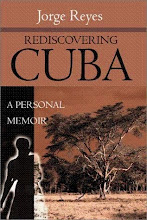
Some years ago I wrote a book about returning to Cuba, Rediscovering Cuba: A Personal Memoir. My ideas then, as much as they are now, have changed little. Cuba's present-day reality is complex, too complex. Many people have an interest in Cuba's future, and many have a stake and a moral right, too, at rewriting its history. At the time that I published my book, I sent a copy of the book to one of Castro's sister, Juana Castro, who lives in Southern Florida and who has never seen her brothers since the early 1960's when she left Cuba. In the brief conversation she and I had, what I found in her is the same type of closely-guarded testimony of a Cuban who not only is divided between family love and the divisions all too common for the Cuban people. Juana Castro congratulated me on the publication of my book. I said that I was honored that she'd taken her time to call me. The conversation was polite, but distant. She knew I could have thrashed and demonized the family whose name she bears, the Castro name. I honestly hadn't. But what I found in her was that when it comes to speaking about Cuba, there are no easy answers. I refrained from asking too many indiscreet questions about her brothers, about her family, about her views on Cuba. She herself kept mum about saying anything at all. Hence the intractable silence, the impasse that exists between two countries, two people, and misunderstanding amonng generations subtly divided over an issue that in the past was easy to ascertain as one cause, with one name-- with one common hatred.

24 November, 2007

Evil in modern literature


What do we make of actions stemming from individuals or people that cannot be accounted for; evil, for example, comes to mind.

Evil as a force can be legitimized in only two ways: in a Manichean struggle between good and bad, each battling for dominion in earthly life. Problematic as it may seem, most of our concept of evil is infused with this earthly struggle, which is also cosmic and transcendental in nature, but which posits human freedom and the ability to choose one from the other as the only redemptive way out of this impasse. Hence, we often tend to judge actions according to our inate ability to choose the good over the bad, or vice versa.

In truly heinous acts, we seem to believe in the infallible epistemological verity of goodness when bad is punished, often as compared to some principle or other, and as a society we buy into the reassurance that after all this is the best of all place, after all, to paraphrase Voltaire's Candide, and that justice ultimately is achieved.

There are a few books that have been published lately, each diametrically opposed to each other except by the thematic issue of evil, that bring into the fore of popular discourse the meaning of evil in modern time. Assuredly, in what is recognized as a post-911 society, trying to come to grips with evil is timely. One of these books is a book of fiction titled The Castle in the Forest, written by the darling of American letters, Norman Mailer, (1923-2007).

There are other books on this subject-matter, and they each grapple with what has now become a clique, a terminology that describes evil as banal, something devoid of character. This phrase, coined by Annah Arendt (1906-1975) in her book Eichmann in Jerusalem, based on her reporting of the Adolf Eichmann trial in 1963, has vastly contributed to our present-day discussion on evil in modern political thought, though not without some controversy. Hers was a phrase that didn't seem to settle anything. This is more astonishing by the fact that she liked to think of herself as a political theorist whose overall theories was based on "men, not Man," or "man in the singular."

But her banality of evil phrase outlasted its usage by the manner in which evil has been defined historically. Instead, seeking ways to save human nature from horrendous potentials and acts of genocide, it was better to comprehend the incomprehensible or "inhuman" by distancing each from the other first by distancing it from a moral point of view, and then from an epistemological one.

Regardless, it was the best antidote to that vast plain field of post modern barenness we seem to have fallen trap to, and not inevitably I might add.

Evil, in the presence of Goodness, should not exist, or should it? If it does, can evil be called anything other than human, all too human, fated for defeat if defeated, fated to triumph if it does? Is it something so radical that to call it inhuman would, then, be appropriate? or is it? is it banal to the point that it is both devoid of radicality and then it becomes, ipso facto, not inhuman, but part of us? Hence Hitler's mass movement.

But what gives rise to it in the first place and, when it does in quantifiable ways, how are we to reprehend it for what it is? What drives some people to mastermind acts of genocide that gives rise to our concepts of evilness? And when it does, whence does it come from? And, most alarming, for what purpose?

Mailer, no stranger to controversy if his life and not his fiction is analyzed, sets out to write nothing less that Adolf Hitler's early life as seen through the eyes of devil. This devil is just one invisible and not all powerful demi-evil-god who answers to an even larger devil whom he calls the Maestro. Little is written about goodness, or someone whom we can refer to as a Maestro of goodness. In fact, nothing is written about the opposite of evil and we soon enter into the lives of normal-seeming people, even when we are brought face to face with a kid whose actions, while odd, don't come close to foretelling the acts of genocide he ultimately was responsible for perpetuating.

As problematic as Arendt's banality, Mailer's is no different, and for the same reasons. In Mailer's cosmology, there is a struggle that even reduces the very substance that pits good versus in evil, when evil these devils don't know what it is that makes them follow the order of high-above, low-below, since it seems devoid also of value. The narrator in the Castle in the Forest just follows the directives of his master, rarely mentions God, and just puts ideas into the people he is slated to lead step by step, everyday, until his mission is accomplished: Hitler the baby turned Hitler the genocidal mass murderer.

If Mailer grappling with Arendt's own post-modernism, he fails since in his desire to find meaningful explanations that are not merely descriptive actions, he takes the moral imperative against evil acts by making his characters, in effect, innocent of responsibility. This is at first ironic from a man who once went on record arguing against this same problem: "If Hannah Arendt is correct and evil is banal, then that is vastly worse than the opposed possibility that evil is satanic."

In other words, if the struggle is between something that is banal, not necessarily substantial in nature (definition is mine), then any act termed evil is just a tautological description. What's the same, the 10,000,000 millions who died in World War II is no more an act of indifference and caprice of a strange group of people that liked to be part of the Third Reich under a leader known to be the Fuhrer, than it is for a psychopath mass murderer who goes on a killing spree of women and who, though resposible, is no more accountable for his actions than Hitler himself.

The irony in all of this is that impasse, though intractable, is not at all impossible to imagine.

In our development of western thought, we are all victims to that Platonic division that pits "concept" against "reality"; its implication seems to indicate that we, as finite actors in a worldstage, can understand one's ultimate meaning only by comparing it to some ineffable world of ideas outside the realm of cognition, and the simple act of seeking to find such cosmic mana by which we seem to base, compare and contrast all of our actions, is an act to self-defeat from the first-go.

It reminds me a lot of the strange circular reasonings many philosophers seem to have rebutted their own philosophies by concluding that the conceptual is a fiction, that we should nonetheless seek to believe in it as if it existed in reality. The paradox is at first startling, but that's exactly the sets of ideas which have made us heirs to a culture, and individuals.

Only those who are really wise enough to be members of an elite group of philosophers with knowledge in esoteric mysteries, can understand and guide the rest of us. Therefore, our inability to fully place bad actions in the context of a meaningful dialogue that places both concepts and reality as one and the same and makes, in a plethora examples, all actors accountable for their own actions for to act without ideas is not to act beyond grunts and hunger. To continue to divide and believe in this bipolar existence of the above and below, the cosmic and the human, we fail to undestand that meaning can only be understood without recurring to phantoms that plant the seed of doubt in our heads, but makes each of our actions based on either freedom, or its lack; concepts inately part of our actions; play and act one and the same.

In many ways the pre-Socratic materialists, Epicurus, Democritus and Epitectus we closer to the modern impasse when they described the world as being finite and of one substance, matter, and not as based on two substances, matter and spirit. Perhaps each was defining a truth into itself, matter and spirit may be one, not two, but very few except the bravest at heart have taken on this challenge with any level of persuasiveness. Our canon tends to immediately shut that possibility up twenty-five hundred years ago.

Mailer can't account for Hitler's monstrous acts, but neither can many of his peers. Their attempt to understand something that cannot be acounted for is noble, but only when placed within the context of human, not inhuman, acts. To Arendt that was the major issue. In fact, how can one judge war crimes or heinous acts if those acts are deliberately inhuman. Inhuman? If at issue it was inhumanity, then I'm not sure how one can judge such acts because to separate the human from the context of the acts is to call such, indeed, banal though there is nothing banal about murder, or genocide.

Since Hitler's suicide in 1945, we have yet to understand how someone like him could have driven one of the most liberal-minded cultures in Europe to a culture that accepted crematoriums for human beings. To get to know in-depth the real Hitler would fail at many levels, and current books both fiction and non-fiction are prove to such. Even to those who knew Hitler personally and survived World War II, fail to come to fully describe the monstrosity he created. Of course, it is a monstrous act that he couldn't have done on his own, like most crimes are never committed just by one person.

Of Albert Speer's memoirs which is a whopping 600+ page book, there are no more than five or six pages, at the most, which he describes concentration camps, and only in the most perfunctory manner. Of another survivor of the Hitler gang is that of his personal and faithful secretary, who wrote her memoirs of the last days of her Fuhrer right after World War and her words are just excuses are just ritualizations of her days working as secretary to a killer and her remunerations of his last days, deeply entrenched under group in his bunker.

All these books, and I've only mentioned a four in a vast bibliography of the subject matter, fail to describe murder for what it is: inexecusable acts committed in the daily routine of our lives. Perhaps we fail to analyze whence these acts occur because to dig too deep into the cavernous motives for our actions is to tread of thin ice. Hitler, before becoming the Fuhrer, seems to have been a normal with strange ideas, but not necessarily dangerous. Stalin and Mao, or any other psychopath, before becoming politically powerful looked like you and I. They may have come out of highly dysfunctional families, but many of us do and hardly all of us become mass-murderers.

Is evil, then, something that we can call "banal" in a society long used to allowing evil acts in a non-judgmental manner? Hardly, it was always an untenable though thought-provoking facile way to strip our collective guilt of any culpability. Is evil, then, something for which we as actors in a world stage claim innocence of? Hardly, it never was though we felt better knowing that it was convenient to strip thought from action; concept from reality; life from death.

I would like to develop this line of reasoning later on as I analyze the demarcation between thought and reality in tragedy, especially as it has been defined in works of fiction of both elder and modern times.

30 October, 2007

Amanda, my cat-- on losing a beloved pet


Not that I'm a philosopher or an intellectual savant, but in the past I've written about the meaning of life.  It is a topic that interests me a great deal.  Particularly at life contrasts with death.

I've seen my fair share of deaths-- from family members to coworkers and acquaintances.  Not a day goes by without us being subjected to the topic in the tv or print media. 

Death is unexplainable. It is never an easy thing to explain, to oneself particularly, much less to those affected by its effects.  When this loss is from a loved one, not just from an acquantaince, then the sense of loss is never resolved despite how one can categorize it.  No explanation ever fully satisfies.  Death is final. 

Just recently I experience such an emotion, but not from the death of a person, but from a beloved pet, Amanda, one of four cats I had. 

Amanda was a large, white cat with black spots.  She was high-strung, energetic, vivacious, but elegant and loyal as well. Being an outside cat, one of her habits was to wait for me to open the door to my house so she could sneak in and eat with my two other inside cats.   No matter how many times I admonished her for it, she always did it.  It became a habit, and I ultimately gave up reprimanding her and actually waited for her at the door.  

Just about five days ago, though, she died of what seems to have been a massive intoxication. The vet doesn't know what it was, just that such a strong, healthy and lovely cat died horribly of convulsions I never imagined I could endure. During the night, I'd hold her, giving her my mother's favorite anti-intoxicant, oil mixed with milk, a combination that, she assured me, would force her to vomit whatever Amanda had eaten, and make her return to her normal health again.

She never did. When I held her, she'd give me this glazed look, still loving and warm, but it was a look that seemed from some far away creature blinded to my caresses. She seemed to have been going from this life, faster than I assumed, and had resigned to her fate.

The next day, as I called the vet to find out her fate, he informed me that her body temperature was at the level of an animal who'd given up and was just waiting to breathe her last breath, as she was. Last I saw of her was of Amanda under sheets, still with convulsions, breathing but not for life, breathing in a lifeless way, from her stomach.

And so, I knew that the inevitable couldn't be forestalled. I let it be.

What gets to me about death is not so much that one has to resign one's self to the fact that when one is gone, it seems as if a precious prism of light is gone forever. And it is. One can't replace a dead one, one can only be left with its memory, and even that has a funny way to be replaced by the realities of daily living. Thereafter, what's left?

We're all at the whims of a breeze. We're very little, though we assume that our mere presence in life is sufficient to solidify our worth in a cosmos often devoid of much meaning, if at all. I, you, all of us, are left with such sense of unfairness, disappointed, and anger. Often each of these emotions follow that pattern, often they come and go as easily as our memories bring us back to a particular time in the past when we remember a particular eccentricy or habit about those people and pets we lost and were left behind in that great void called time.

Since the inception of civilization, man has tried to enrich the wonder of life by embillishing it with meeaning. It would be so cruel, so wicked, to realize that despite everything that is given to each of us in the form of life, that in the end it would revert to that same dark, meaningless void from whence we seem to have jumped up from with that cry of pain ro joy, with that whimper of hunger, with that look o hunger we find in a small insignificant kitten we rescued from a parking lot.

That's how I'd like to think of this death. Amanda was merely a cat, a pet, but a being whose unexpected loss has caused me a great personal void. Writing this I can't even comprehend the intensity of it any more than I can help writing these words hoping that they could bring some closure to my feelings, though I won't fool myself-- trying to understand the incomprehensible never fully satisfies, and, the way I see it I will always try to figure out if things could have happened differently on that fateful day of October 25, 2007, when my cat died. 

My Amanda's dead. That's all I can say.

08 October, 2007

Between Being and Non-Being


At the heart of our fears, the essence of our innate tremors, is the individual's cessation of life, our own death. Fear of such mirrors many of our mores, belief systems, and, of course, personal outlooks, even the quality of our lives. Added to our own personal annihilation, is the ending of life, the world around us, life as we know it.

Each is intrinsically connected to the other; in personal extinction, we can be assured that life will cease to be as we cognitively know it, but we can be reassured that life will continue, without us, unending it seems. This has tragi-comic consequences. How depraved to think, no matter how we become reassured that death is part of life, how cruel to feel that a life that sustained our personal existence, can also sustain our personal non-being. It is a canvas from which our eyes will be blinded to; it is a radiance from which we will excluded, forever. At least when we refer to personal death, our culture has built-in coping mechanism by which our belief systems have lent us the reassurance that our lives, perished from physical unity, will continue to live, somehow, and perhaps, ironically, forever. It is a life that exists beyond our perception, beyond our sight and beyond our cries; but it is a life guaranteed, somehow.

Whether we succeed in blinding ourselves to this belief system, truly believe in it, or truly exists, the facts remain that it is very difficult to predict the moment when death sets in. Life doesn't exist in a vacuum, except as a principle, and what seems to be the ending of a particular form of personal existence, may well be the impetus for a different way of being; a recycled form of energy feeding off from one form of life to another.

This is true, even in death at a general level, such as the end of the world, the end of life as we know it and not just at a personal level. The end of life as it could happen in a catastrophic cosmic collision, a nuclear war, or the inevitable end of life one day.

How will this life be, then? First, we can understand that our way of life will continue, even without us, through the legacy, memories or individual achievements we may have created. What we can never understand, even beyond this personal death, is how a new world will emerge depopulated of humans.

This is an intricate and strange position to analyze for we know that life will cease to exist, with or without us, and a timetable is generated then most likelier than not that it will exist without us. The human animal is not the oldest, nor the smartest. We simply are the most vulnerable, come to think of it. Without any greatness to immortality, without any history of survival in a non-human related catastrophe, we are one of life's weakest of living beings.

Yet, the sordid and morbid thought of death, however it is defined, at a personal or general level, is at the core of most of our daily rituals. It fascinates us, as much as it repels it. One implies the other; and for one to exist, the other must cease to be. Between this being and non-being, existence remains, transmogrified into something else, yet pretty much taking on a different energy.

As far back as any of us took pen and pencil in hand, as far back as anyone thought to express the indescribable into some form of symbolic meaning, we have been more fearful to answer the unanswerable than we care to know. Death is final, or so it seems, from a personal and egocentric point of view. It is not only final, it is annihilation of the self, which is something beyond finality. Finality implies a new form of beginning, (perhaps in an afterlife or in a regenerative energy), annihilation implies nothing beyond it.

But as I wrote, a world that ends in one form can regenerate itself into a new form of life. Energy refuses to die, it simply is channeled into something else, new energy. A world depopulated of the human animal is something which gives even the best science fiction writer room to pause, meander in millions upon millions of possibilities, and, in fact, it is something that has been food for creativity in that literary genre which became very popular in the Victorian age, and which H.G. Wells is most famous for.

H.G Wells grappled with these questions and in his many writings, he seems to have been looking for a way out, a way to integrate death as much as life into a world-view that shunned none, but understood the implications of each, with possible ways out of this mess, though none to his satisfaction. Hence, Wells wrote books about creating utopian societies which reverted, when all was said and done, to its opposite, dystopias. Of this the most fascinating is The Island of Doctor Moreau, an eccentric and amoral scientist who lives in an island surrounded by animals vivisected into human beings. The animals, though odd, act and think like human beings, but up to a point. Ultimately, Doctor Moreau left the island taking some of these half-creatures with him to England. As expected, these animals reverted back to their animal self.

A thematic sub-layer of transmutation and death seems to run in many of Wells's stories. Not only about the essentialist nature of life, which involves that revolving door that is life and death, but its impenetrability; its lack of coherence as well as it creative force. Wells never said when the end of the world would be, but he sure wrote about it in his other more commercially successful novels, many of which have been made into movies.

Some daring souls have attempted to posit a time when the end of the world would be. Among these was Sir Isaac Newton, founder of modern physics. Curiously enough, not too long ago some of his personal documents were discovered and put up for auction in the United Kingdom. One of the most fascinating one of these was a letter he wrote in which he wrote that the earth would end in 2060, or, 1600 years after the founding of the Holy Roman Empire.

A recent book by Alan Weisman titled, "The world without us," dares to go with scientific precision where right up until now only those of a feverish mind have ventured to go. His main thesis is simply, yet alarming: what will happen in a post-human world?

Well, here's what will happen once we're all gone: in 2 days the New York Subway will be filled with water; in another 20 days Lexington Avenue in Washington will be a river and many skyscrapers will come tumbling down; after 60 days or more, all of the world's 411 radioactive nuclear plants will meltdown, not to mention that petrochemical plants will become flaming geysers and its toxins be around for decades.

But there's more, and the next facet is fascinating to observe as it seems that life will contract and revert to what it was, hence it would be a return to nature. Our cities will become wilderness, slowly of course, not all at once. Carbon-dioxide will revert to pre-human levels of 100,000 years ago. Domesticated species, or those which will survive, will also return to a state of nature, wild and free, as these same surviving species will revert the slow track across time to forest grasslands. In a million year thence, whatever species manages to survive and gain a level of consciousness will only be fascinated to know and understand some of the peculiarities about us which may have survived, fossils mixed with Barbie dolls.

Which brings me to this point: why do think that we're any different and somehow special among other species and within the world around us? do we still think in that God of the bible which creates life in a few days, fashions people out of dust and are his mere image? I think it is a comforting idea that what we may have gained in consciousness, and hence being able to understand and feel without the marrows of our bones how we will perish, the tragi-comedy of our lives is more to be pitied than not.

If God exists, then somehow our travails in this sad existence we call "life" perhaps can be put into sort of coherent storyline, not something that could have been wasted. On the other hand, if there is a God upon whose ultimate judgment we base our inherent worth and meaning, then this same God didn't seem to have favored any of us as opposed to other forms of life, non-human life, or whatever. It seems this God fell asleep at the switch, really.

Life and death, both, are part of life and it strikes the rich as much as the poor, the human as much as the non-human, and whatever may reside beyond it has nothing to do with what we may choose to happen; mainly, preserve the personal ego from what it may never be separated from the machinery that controls it: that which will perish as either a personal self, or as a general species. And for that, which is the conclusion of our story, the results are the same, theistically speaking or shunning any allusions to transcendence.